Vegetable Names Chart
What Is a Vegetable Names Chart and How Does It Support Early Learning?
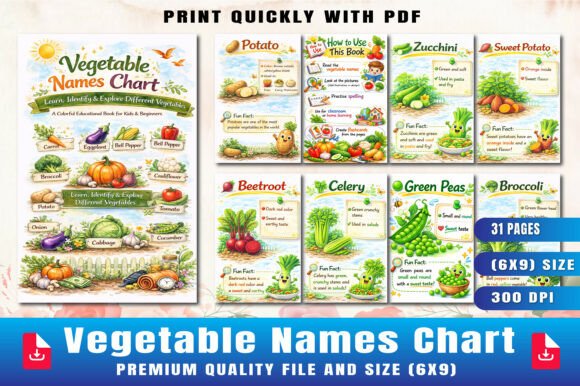
A Vegetable Names Chart is a structured reference tool designed to help children recognize, read, and remember the names of common vegetables. The 30-page educational eBook version expands this concept into a full learning resource, organizing vegetables into categories such as root vegetables, leafy greens, fruit vegetables, flowering vegetables, pod and seed vegetables, stem and bulb vegetables, and colorful varieties. Each page includes the vegetable name, a simple description, and color information, all presented on a clean white background with bright, colorful headings and a child-friendly layout. The format is intended for preschool, kindergarten, homeschool, and classroom settings, and the files are delivered as high-resolution JPG and print-ready PDF at 300 DPI.
For parents, educators, and caregivers evaluating tools to build early vocabulary and food awareness, a Vegetable Names Chart represents a focused, low-distraction approach. It does not gamify learning or rely on interactive elements. Instead, it offers clear visual and textual repetition, which can be effective for children who respond well to structured, predictable formats. Understanding what this resource is—and what it is not—helps in deciding whether it aligns with a child's current learning stage and temperament.
Why Consider a Vegetable Names Chart for Your Child or Classroom?
Several practical reasons make a Vegetable Names Chart worth evaluating. First, the categorization by vegetable type mirrors how many preschool and kindergarten curricula introduce food groups and plant parts. A child learning that carrots are root vegetables while spinach is a leafy green builds foundational science vocabulary alongside reading skills. This dual benefit—literacy and basic botany—adds educational density to what might otherwise be a simple naming exercise.
Second, the inclusion of a practice page and a final review page gives the chart a built-in assessment structure. Teachers and parents do not need to design their own review activities; the book provides a natural checkpoint. For homeschool settings, where self-paced review is valuable, this structure reduces planning time.
Third, the 6x9-inch page size and white background minimize visual clutter. Some children, particularly those with attention or sensory sensitivities, perform better with clean, high-contrast materials. The bright headings add interest without overwhelming the page. For educators selecting materials for a diverse classroom, this design choice accommodates a range of learners.
Benefits of Using a Vegetable Names Chart
Clarity and consistency. Each vegetable page follows the same layout: name, description, color. This repetition supports memory formation. Children learn to expect the same structure, which reduces cognitive load and allows them to focus on the content.
Print or digital flexibility. Because the files are provided as high-resolution JPGs and a print-ready PDF, the Vegetable Names Chart can be used on a tablet, printed as a book, or used as individual flashcard-style sheets. This flexibility matters for families who prefer screen-free time or for classrooms with limited printing budgets.
Broad vegetable selection. Covering root, leafy, fruit, flowering, pod, stem, and colorful vegetables, the chart exposes children to more than just the common eight or ten names. Including items like leek, zucchini, and beetroot expands a child's vocabulary beyond typical picture books.
Tradeoffs and Limitations
No interactive or multimedia elements. The Vegetable Names Chart is a static resource. For children who need games, sounds, or animated content to stay engaged, this format may feel flat. It relies on an adult guiding the session or a child who is already comfortable with book-based learning.
Minimal depth per vegetable. Each entry includes a name, a brief description, and color information. There is no nutritional data, growing information, or recipe connection. If the goal is to teach children where food comes from or why vegetables are healthy, supplemental materials will be necessary.
Page count and perceived value. Thirty pages at 6x9 inches is a modest book. Some buyers may expect more content per page or a larger format. The value lies in the clean design and categorization, not in volume. For those comparing by page count alone, a thicker workbook might seem more substantial.
When Is a Vegetable Names Chart a Strong Fit?
Structured learning environments. Teachers planning a unit on plants, food, or healthy eating will find the categorization aligns well with lesson plans. The chart can serve as a reference during a vegetable tasting activity or a garden visit.
Emergent and early readers. Children who are beginning to recognize sight words and short sentences benefit from the repeated sentence structure. The simple descriptions use predictable language, which builds reading confidence.
Homeschool families seeking low-prep resources. A parent managing multiple children or subjects will appreciate that the Vegetable Names Chart is ready to use immediately. The included practice and review pages mean no extra worksheet creation.
Children who enjoy categorization and order. Some children naturally gravitate toward sorting and labeling. For them, a chart that groups vegetables by type is inherently satisfying and encourages independent exploration.
When Alternatives May Be Worth Considering
For children who need high engagement. If a child loses focus during static activities, a vegetable-themed memory game, a lift-the-flap book, or a digital app with pronunciation audio may hold attention longer. The Vegetable Names Chart assumes a certain baseline of focus that not every child has developed.
For classrooms with very limited budgets. While the downloadable format is affordable compared to a printed book, completely free resources exist online. Teachers searching for zero-cost options may find printable flashcards or coloring pages that cover similar content, though without the structured categorization and review pages.
When the goal is deeper food education. A parent wanting to teach children about vegetable gardening, cooking, or nutrition will need to supplement this chart significantly. In that scenario, a comprehensive food education curriculum or a children's cookbook might be a better primary resource, with the chart used as a supporting reference.
Practical Decision-Making Insights
When evaluating a Vegetable Names Chart, consider the child's current learning style and the adult's available time for guidance. This resource works best when an adult is present to read the descriptions, point to the vegetables, and reinforce the categories. It is less suited for independent play or silent activity, because the text requires at least early reading ability.
Also consider how the chart fits into a larger learning plan. Used weekly as part of a food-themed unit, it can reinforce vocabulary over time. Used once as a standalone activity, it may not produce lasting retention. The review page helps, but spaced repetition across multiple sessions will strengthen memory.
For educators, the Vegetable Names Chart can function as a low-stakes assessment tool. After a unit on vegetables, asking a child to name the vegetables on each page or sort them by category provides observable data on vocabulary acquisition. The clear layout makes it easy to track which names a child has mastered and which need more practice.
For parents, the chart can also serve as a mealtime conversation starter. After reviewing the pages, pointing to a bell pepper or a leek at the grocery store or on the dinner plate connects the chart to real life. This transfer from page to practice is where the chart's true value emerges—not in the number of pages, but in how it equips a child to recognize and name vegetables in their everyday environment.
Aligning the Vegetable Names Chart With Your Goals
If your goal is to build vegetable vocabulary in a quiet, structured, and reproducible way, the Vegetable Names Chart is a practical choice. Its categorization, clean design, and included review pages make it easy to implement without additional preparation. The print-and-digital flexibility means it can adapt to different home and classroom setups.
If your goal is to engage a reluctant learner, teach cooking skills, or provide entertainment, the chart alone will likely fall short. In those cases, treat it as one component of a broader toolkit rather than the centerpiece.
Ultimately, the Vegetable Names Chart is a focused resource for a specific purpose: helping children learn vegetable names through repetition and categorization. It does not pretend to be a full curriculum or an interactive game. For families and educators who value that clarity, it delivers exactly what it promises. For those seeking a more dynamic or comprehensive approach, it can still serve as a useful supplement when paired with other materials.
Before purchasing, review the number of vegetables included, the page size, and whether the practice and review pages match your child's current skill level. If the format aligns with how your child learns best, this chart can become a go-to reference for early food vocabulary and reading practice alike.