2026-27 Rainbow Budget Planner: A Complete Financial Planning Tool for the Next Two Years
Managing personal or business finances across a two-year horizon demands more than a simple spreadsheet or a single-year notebook. The 2026-27 Rainbow Budget Planner bridges that gap with a structured, visually clear system designed to track income, expenses, tax deductions, and sinking funds across 2026 and 2027. Whether you are a freelancer juggling multiple projects, a small business owner monitoring cash flow, or a household planning major purchases, this planner provides the scaffolding to turn financial intentions into consistent action.
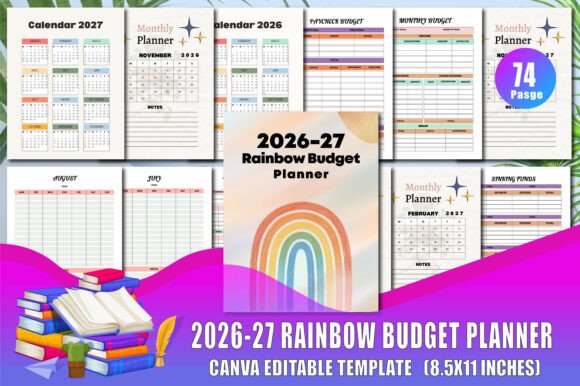
Unlike generic budget templates, the rainbow planner integrates monthly calendars, holiday reminders, weekly budgets, and yearly overviews into one editable Canva interior. The result is a tool that works both as a print-ready PDF for Amazon KDP and as a customizable digital file you can adjust to fit your exact workflow. This article unpacks what the planner includes, how it interacts with your existing financial routines, and practical ways to implement it over the coming months.
What the 2026-27 Rainbow Budget Planner Offers
At its core, the planner merges calendar management with detailed financial tracking. The "belongs to" page personalizes ownership, while the 2026 and 2027 calendars list holidays—useful for anticipating seasonal spending or billing cycles. Each month from January 2026 through December 2027 appears with dedicated sections for weekly budgets, monthly budgets, and paycheck allocations. Beyond the monthly pages, you get a yearly calendar overview, yearly expenses summary, budget overview, income tracker, expense tracker, tax deductions log, and sinking funds tracker.
This structure moves beyond simple spending logs. By separating tax deductions and sinking funds, the planner helps you prepare for quarterly tax payments, planned major purchases, or irregular expenses like vehicle maintenance or annual subscriptions. The Rainbow theme is not just aesthetic—it helps visually distinguish categories, making scanning and revising faster.
Who Benefits from This Two-Year Planner
The 2026-27 Rainbow Budget Planner suits a broad adult audience, especially those who manage variable income or multiple financial streams. Freelancers and gig workers can use the income and expense trackers to monitor monthly fluctuations, while the tax deductions section keeps receipts organized year-round. Small business owners can overlay business budgets on personal ones using separate tracker pages, though the planner is designed primarily for individual or household use.
Working professionals will appreciate the monthly paycheck budget pages for aligning fixed expenses with bi-weekly or semi-monthly pay cycles. Entrepreneurs launching a side project can dedicate a few tracker rows to business costs without overwhelming the main layout. Even educators or bloggers can repurpose the budget overview to allocate time and resources to different projects, using the same income/expense logic for tracking affiliate earnings, course sales, or sponsorship payments.
How the Planner Fits into Real Workflows
Integration happens at three stages: before, during, and after your financial planning cycle.
Before the year starts, you set up the planner by entering known income sources, fixed expenses, and sinking fund goals for each major category—vacation savings, holiday gifts, annual insurance premiums, and so on. The Canva interior allows you to edit colors, shapes, and text, so you can rename budget categories to match your actual spending. For example, you might change "Transportation" to "Delivery expenses" if you run a food truck, or split "Groceries & Dining" into two separate lines.
During the month, the weekly budget pages become your operational dashboard. Each week, review the paycheck budget to see if your upcoming income covers the week's planned spending. As you incur expenses or receive payments, record them in the expense and income trackers. The holiday notes on the calendar help you anticipate three-day weekends that might reduce billable hours or increase travel costs.
After the month ends, transfer totals to the monthly budget overview and compare them against your original allocations. The yearly expenses page lets you spot trends—like rising utility costs or seasonal dips in freelancing income—that inform next month's adjustments. The tax deductions page accumulates throughout the year, saving you from scrambling every April.
Practical Implementation Tips
To get the most from the 2026-27 Rainbow Budget Planner, treat it as a living document rather than a static record. Here are workflow-tested approaches:
- Customize the Canva file before printing. Add your own column headers, adjust color coding for different income types (e.g., blue for salary, green for freelance), and resize cells if you prefer more space for line-by-line entries. Because the file is editable, you can also merge or split months—for instance, adding an extra "Quarterly review" page between March and April.
- Pair with a digital tracking app. Use the planner on paper for weekly reviews and a simple app (like a Notes file or a free spreadsheet) for daily logging. Then transfer lump sums to the planner each weekend. This hybrid approach keeps the planner clean and reduces transcription errors.
- Use sinking funds consistently. For each fund (car repairs, dental, holiday gifts), set up a row in the sinking funds tracker and update it whenever you set money aside. Over two years, you will see exactly which funds are undercapitalized and which you can trim.
- Involve your partner or team. If you share finances, designate a weekly 15-minute "planner sync" where both of you update the expense tracker and review upcoming budget lines. The clear layout makes this collaboration efficient even if one person is less numerate.
- Print only the pages you need. For the first year, you might skip 2027 pages until spring 2026. Or print all pages and bind them as a two-year journal. The print-ready PDF files are optimized for Amazon KDP, but you can also upload them to a local printer for a customized size.
Usability and Organization Considerations
The rainbow color scheme serves a functional purpose: each budget category can be assigned a color, so a quick glance at the yearly expenses page reveals overspending hot spots. The monthly calendars are large enough to mark due dates for bills, tax deadlines, and income deposits. Holiday names are included, which helps when planning travel or anticipating office closures.
Consistency is built in. Each month repeats the same layout—budget overview, income tracker, expense tracker—so after two or three months, filling out the pages becomes automatic. The 2027 calendar mirrors 2026's structure, making transition seamless. For quality control, check that your edits in Canva align with the PDF dimensions (likely US Letter or A4) before uploading to Amazon or your print service.
Long-Term Use and Adaptability
Because the planner covers two full years, it encourages longitudinal thinking. You can compare January 2026 spending with January 2027 to see if your financial habits improved. The yearly expenses and budget overview pages aggregate data for both years, giving you a macro view that single-year planners lack.
If you prefer a more minimal approach, you can remove pages—for example, skip the paycheck budget if you are salaried with predictable pay, or omit the sinking funds tracker if you have no irregular expenses. The editable Canva interior makes this straightforward: delete unused pages, rearrange the order, or add extra blank pages for notes. The file is ready to upload as is, but the real power lies in tailoring it to your exact process.
Integrating with Other Tools and Methods
The planner works well alongside zero-based budgeting, the 50/30/20 method, or envelope systems. For zero-based budgeting, use the monthly budget overview to assign every dollar of income—the income tracker shows total incoming, and the expense tracker forces you to allocate until the difference is zero. For the 50/30/20 approach, create three master categories (needs, wants, savings) and subdivide them within the monthly pages.
If you already use a digital tool like YNAB or Mint, the planner can serve as an offline backup or a weekly review sheet. Print the monthly overview and reconcile it with your digital dashboard each week. The tax deductions page alone saves hours during tax season by providing a clean list of deductible expenses.
Final Observations
The 2026-27 Rainbow Budget Planner is more than a colorful notebook—it is a structured system for financial clarity over two critical years. Its strength comes from combining calendars, multiple budget formats, and dedicated trackers into a single, customizable file. Whether you upload it to Amazon KDP as a saleable product or use it personally, the planner rewards careful preparation and consistent use. Start by editing the Canva interior to your categories, print a draft, and test it for one month. Once you see how the weekly and monthly views connect, the rest of the year will fall into place with less friction and more control.