ADHD Daily Planner Focus Routine Log
For anyone navigating the daily push and pull of adult ADHD, the idea of a planner often brings up mixed feelings. You probably know the cycle: buy a planner full of hope, use it for three days, misplace it, find it a month later, feel guilty, and then start the search again for the one that will actually work this time. The ADHD Daily Planner Focus Routine Log is designed to break that cycle. It is not a rigid calendar system demanding perfect adherence. Instead, it is a flexible, low-friction structure that works with the way your brain actually operates. It centers on three distinct layouts across three separate PDF files, each with 120 pages, giving you room to figure out what fits without wasting pages or money on a system that sets you up to fail.
Why this planner works differently for the ADHD brain
Traditional planners often assume a linear, neurotypical relationship with time. They expect you to check in every hour, assign rigid time blocks, and follow through without much friction. For adults with ADHD, that kind of structure can feel like a cage. The ADHD Daily Planner Focus Routine Log flips that assumption. Instead of punishing you for how your attention works, it offers three approaches so you can match the tool to your current mental state. Some days you need a strict routine to hold you together. Other days, you just need to track what actually happened so you can see where your time went. That variety is not a gimmick. It is a practical acknowledgment that executive functioning fluctuates from one day to the next.
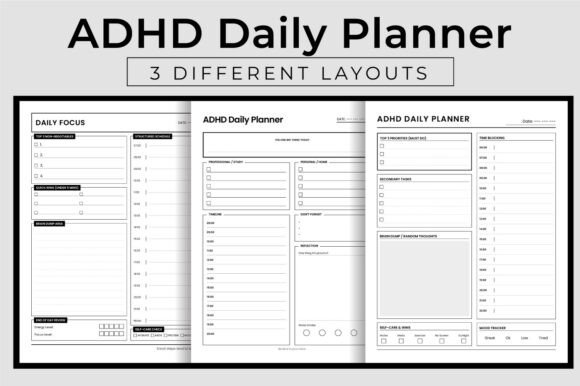
When you open a PDF file that is ready to print at home or load onto a tablet, you are not committing to a year of a single format. You can switch between layouts depending on the season of your life. Maybe you are in a high-focus phase at work and need the productivity tracking version. Or maybe you are recovering from burnout and need the gentle routine log that does not demand much. Having three options means you are never stuck with a planner that no longer fits you.
The morning scramble before work
Imagine waking up at 7:30 with a 9:00 meeting you forgot to prepare for. Your brain starts spinning through a dozen unfinished tasks, and none of them get done because you cannot choose where to start. The ADHD Daily Planner Focus Routine Log includes an executive functioning daily task tracker that helps you externalize that mental chaos. Instead of holding everything in your working memory, you dump it onto the page. The simple act of writing down three priorities for the morning can lower the mental load. For the adult who has tried to rely on phone apps but ends up doom-scrolling instead, this physical tracker provides a screen-free anchor. You place it next to your coffee maker. You glance at it while the kettle boils. You check off one small win before you even leave the house.
Freelancers and remote workers managing multiple projects
Working from home without external structure is one of the hardest environments for an ADHD brain. There is no boss tapping your shoulder. No commute that forces a transition. The boundaries between work and rest get blurry, and before you know it, you have spent three hours on a minor detail while a major deadline slips. The structured daily planner for ADHD adults offers a middle ground between micromanagement and total freedom. The focus and productivity layout, for instance, helps you identify one main task per block rather than a packed schedule that tries to predict every minute. You learn to be realistic about how much you actually accomplish in an hour, which is usually less than you think. Over time, that honesty builds trust with yourself. You stop overpromising and underdelivering.
Parents juggling household and family routines
Parenting with ADHD is a separate kind of exhausting. There are school forms, meal planning, appointments, and the constant interruption of small humans who need things right now. The ADHD Daily Planner Focus Routine Log can double as a household command center. Use the routine log layout to track morning and evening habits for yourself. Use the task tracker to keep a running list of things that need to happen this week. The 120 pages per PDF mean you have space to be messy. You can skip a week and come back without feeling like you failed. That flexibility matters when your kid gets sick and the whole schedule falls apart. The planner does not punish you for real life.
Who benefits most from the three different layouts
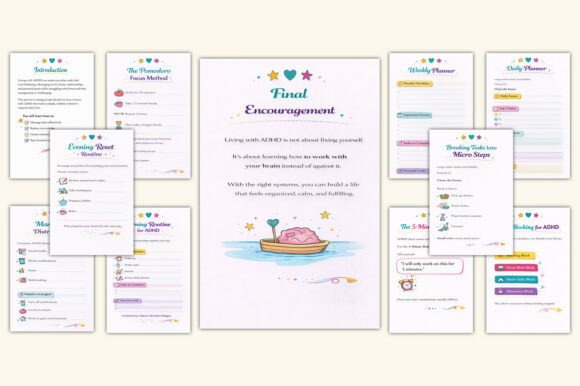
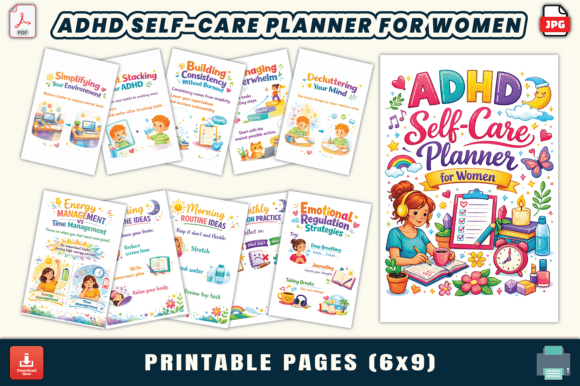
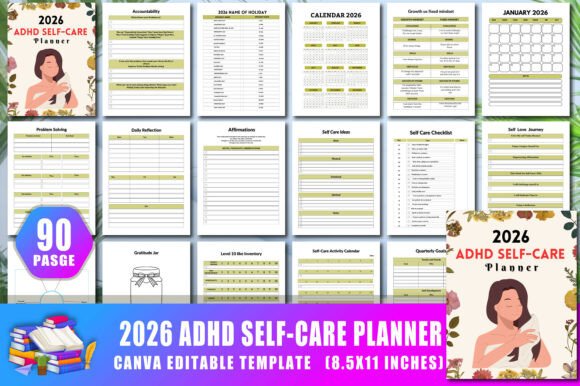
Not every adult with ADHD needs the same kind of planner at the same time. The beauty of this product is that it acknowledges that your needs change. The first layout might be a classic daily focus planner with space for time blocking and a short reflection. The second layout could lean into the executive functioning task tracker, with bigger checkboxes and room for brain dumps. The third layout might be a stripped-down routine log that asks only for a few key habits and a note about how you feel at the end of the day. If you are someone who gets overwhelmed by too many boxes, the simpler layout is your entry point. If you thrive on structure and love checking off detailed tasks, the more complex layout will feel satisfying rather than suffocating.
For students returning to school or adults taking online courses, the planner can become a study companion. Use the focus log to track pomodoros or study sessions. Use the daily tracker to break assignments into smaller, less intimidating chunks. The physical act of writing helps encode the task into memory in a way that digital checklists often do not. Plus, having a dedicated space for distractions means you can acknowledge that wandering thought without letting it derail your entire session. You write it down, promise to come back to it, and keep moving.
Practical considerations before printing or purchasing
Since the files are high resolution at 300 DPI and sized at 8.5 by 11 inches with no bleed, they are ready to print at home or at a local shop. If you are planning to use this for KDP, the no-bleed format makes uploading straightforward. But for personal use, you have options. Some people print the whole 120-page PDF at once and bind it at a copy center. Others print only a week at a time to reduce the pressure of filling a whole book. You might even print the three different layouts separately and rotate through them. The choice is yours, and that flexibility is part of what makes it sustainable.
One thing to consider is paper weight. If you are using pens that bleed through, a heavier paper stock will keep the back side usable. Also, consider whether you prefer to write in pen or pencil. Some adults with ADHD find that using pencil reduces the fear of making a mistake. If you mess up, you erase and move on. That small psychological allowance can make a big difference in whether you keep using the planner or abandon it after a few days.
Strengths and honest limitations
The biggest strength of the ADHD Daily Planner Focus Routine Log is its adaptability. Having three separate layouts in one product means you are not locked into a system that stops working after two weeks. The 120-page length per PDF is generous without being intimidating. You have enough space to build a habit without the waste of a full year planner that only gets used for January. The high print quality and standard size make it easy to handle, carry, and store.
A potential limitation is that the planner is designed for people who are ready to engage with it. If you are in a state of deep overwhelm where even opening a PDF feels too heavy, no planner will help. The tool cannot replace therapy, medication, or professional support. It also requires a small upfront investment of time to figure out which layout works best for you. You might print a few test pages before committing to a full 120-page file. That trial period is normal and part of the process. Do not let the perfect become the enemy of the good. Start with one layout, use it for a week, and adjust.
How the executive functioning daily task tracker changes your relationship with time
Time blindness is one of the hardest symptoms of adult ADHD to manage. You sit down to work on a task, and suddenly four hours have disappeared. The ADHD Daily Planner Focus Routine Log addresses this by encouraging short check-ins throughout the day. The task tracker is not just a list of things to do. It becomes a log of what you actually did. Over time, you start to recognize patterns. You notice that you focus better in the late morning. You see that certain tasks take twice as long as you estimated. That data is gold. It helps you plan your future days more honestly, which reduces the cycle of shame and overcommitment.
For people working in creative fields, the focus log layout can be used to track flow state. You note what time you start, what time you stop, and how focused you felt. After a few weeks, you see the conditions that support your best work. Maybe it is silence. Maybe it is background noise. Maybe it is having a specific drink nearby. The planner helps you become your own scientist, gathering data without judgment.
Using the planner alongside digital tools
Some adults prefer to use the printed planner as their main system and supplement it with a digital calendar for appointments. Others use the PDF on a tablet with a stylus so they can erase and rearrange without wasting paper. The files are flexible enough to work in either environment. If you use a note-taking app that supports PDF annotation, you can keep the planner on your device and never print a page. That approach works well for people who lose physical objects but always have their tablet.
The key is to avoid overcomplicating the system. Pick one layout, one tool, and one habit. Maybe the habit is simply opening the planner with your morning coffee and writing down one intention for the day. That is enough. You do not need to fill every line. You do not need to be perfect. The ADHD Daily Planner Focus Routine Log exists to reduce mental clutter, not add to it. Every page is an invitation to pause, notice where you are, and make a small choice about where to go next. That is the kind of structure that actually helps an ADHD brain thrive.
Final thoughts on finding your rhythm
No single planner will solve every challenge that comes with adult ADHD. But having a flexible, well-designed tool that you can customize and return to makes a real difference. The ADHD Daily Planner Focus Routine Log gives you three distinct approaches in one package, all ready to print at 300 DPI on standard 8.5 by 11 paper. Whether you use it for work, school, parenting, or personal growth, the structure is there when you need it and forgiving when you do not. That balance is hard to find in most planners. Give yourself permission to start messy, try all three layouts, and keep what works. That is the whole point of a routine log. It is not about being perfect. It is about making progress, one small page at a time.