How AI-Powered Fiction Writing Is Reshaping the Creative Workflow for Writers and Professionals
The craft of fiction writing has long been viewed as a solitary pursuit, one that relies on innate talent, discipline, and years of practice. But the emergence of generative tools has introduced a new dynamic into the creative process. Writers, content creators, and even professionals outside the literary world are beginning to explore how artificial intelligence can serve as a collaborator rather than a replacement. At the heart of this shift is a growing recognition that AI can amplify human creativity, not diminish it. This is precisely where AI-Powered Fiction Writing enters the conversation—not as a shortcut, but as a structured method for combining imagination with intelligent assistance.
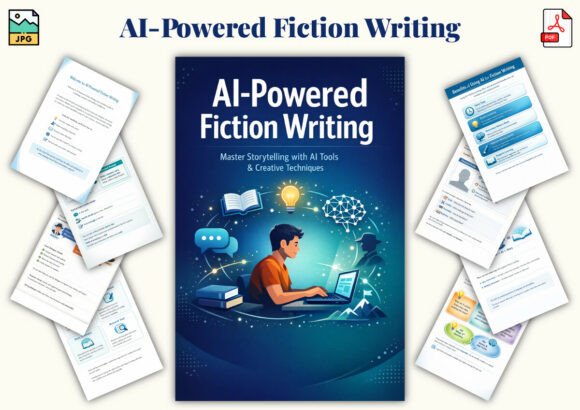
For professionals, entrepreneurs, and freelancers who produce content regularly, the ability to generate compelling narratives quickly is no longer a luxury. It is a competitive advantage. Whether you are drafting a brand story, developing a pitch, or simply looking to improve your creative output, understanding how to work with AI tools in fiction writing offers transferable skills that apply across industries. The AI-Powered Fiction Writing – Ebook Workbook 25 Pages, 6×9 Inches provides a practical entry point into this methodology. It is not a theoretical exploration of AI; it is a hands-on resource designed to help you practice, iterate, and produce better stories.
The Intersection of Creativity and Technology: A New Paradigm for Writers
The relationship between technology and creative work has always been complex. For decades, writers relied on typewriters, then word processors, then outlining software. Each tool changed the mechanics of writing, but none fundamentally altered how stories were conceived. AI represents a different kind of shift. It does not simply help you format or organize—it helps you generate. This changes the entire front end of the creative process, from idea conception to character development to dialogue refinement.
What makes AI-Powered Fiction Writing particularly relevant today is the convergence of several trends. First, the democratization of AI tools means that anyone with an internet connection can access language models capable of generating coherent text. Second, the demand for content has never been higher, whether for publishing, marketing, or education. Third, the gig economy and remote work have created a class of independent professionals who need to produce high-quality work without the support of a full editorial team. In this environment, learning how to guide an AI to produce useful creative output is not just interesting—it is practical.
The workbook format of AI-Powered Fiction Writing is particularly well-suited to this moment. It acknowledges that reading about a skill is not the same as practicing it. By combining educational content with worksheets, it bridges the gap between understanding and application. This is a crucial distinction for busy professionals who want to see results, not just accumulate information.
Why Writers Are Turning to AI-Assisted Workflows
If you ask seasoned writers what the hardest part of writing is, many will say the beginning. Staring at a blank page, waiting for inspiration, is a familiar struggle. AI tools can help by providing raw material—a premise, a character sketch, a snippet of dialogue—that the writer can then shape, refine, and make their own. This does not eliminate the need for skill; it changes where and how that skill is applied.
The AI-Powered Fiction Writing workbook addresses this directly. Its structure includes story idea generation techniques and character development exercises that show you how to prompt an AI effectively and then evaluate what it produces. This iterative process—generate, assess, refine—is exactly the kind of workflow that experienced writers already use internally. The difference is that AI can now provide the raw material faster and in greater variety.
Another reason writers are paying attention is the reduction in friction between idea and execution. In traditional writing, moving from a vague concept to a draft scene can take hours of mental effort. With AI assistance, that same process might take minutes. The writer then spends their energy on editing, structuring, and polishing—tasks that benefit from human judgment and taste. This is not a replacement of the writer; it is a reallocation of their effort toward higher-value work.
How AI-Powered Fiction Writing Aligns with Broader Industry Trends
The rise of AI in creative fields is not happening in isolation. It is part of a larger movement toward augmented creativity, where humans use technology to enhance their natural abilities. This is visible in graphic design, music production, video editing, and now writing. Professionals who embrace this trend are finding that they can produce more, iterate faster, and experiment with ideas they might not have considered otherwise.
For content creators and marketers, storytelling is a core competency. Brand narratives, case studies, email campaigns, and social media posts all rely on the same underlying principles as fiction: character, conflict, and resolution. Learning to apply AI to fiction writing is therefore not a niche skill; it is a way to practice narrative construction that can be transferred to any professional context. The AI-Powered Fiction Writing workbook includes plot structure and storytelling frameworks that are directly applicable to business and marketing writing.
For educators and students, the workbook offers a structured way to teach both writing and AI literacy. As schools and universities begin to incorporate generative AI into their curricula, having a resource that focuses on educational content and practical worksheets becomes valuable. It provides a safe, guided environment for learning how to interact with AI without relying on it to do the thinking.
For digital product sellers, the workbook itself is an example of how AI-related content can be packaged and sold. Its KDP-ready format, 6×9 inch size, and print-ready PDF make it easy to reproduce and distribute. This reflects a broader trend in the creator economy where niche educational products are in high demand.
Practical Examples: From Blank Page to Finished Story
To understand how AI-Powered Fiction Writing works in practice, consider a common scenario. A writer wants to develop a short story but has only a vague idea about a character who discovers a hidden message. Using the workbook's story idea generation techniques, they prompt the AI with a few keywords—maybe "old letter," "unexpected truth," "small town." The AI returns several premise ideas. The writer selects one that resonates and then uses the character development exercises to flesh out the protagonist's background, motivation, and voice.
Next, the workbook guides the writer through plot structure and storytelling frameworks. They decide on a three-act structure and outline key scenes. The AI can then generate a rough draft of each scene, which the writer edits for tone, consistency, and emotional impact. Finally, the editing and improvement checklists help the writer review pacing, dialogue quality, and narrative cohesion. The result is a polished story that the writer can publish, share, or use as a portfolio piece.
This process is not hypothetical. Many independent authors and content creators are already using similar workflows to produce novels, serials, and short stories. The workbook systematizes this approach, making it accessible to anyone regardless of their prior experience with AI.
Changing Expectations: What Audiences and Clients Want Now
The expectations around content have shifted. Readers and clients are no longer impressed by simple volume—they want quality, originality, and speed. AI-assisted writing can deliver all three, but only if the writer knows how to manage the collaboration. This is where the step-by-step guidance in AI-Powered Fiction Writing becomes essential.
Freelancers who offer writing services are finding that clients increasingly ask about AI capabilities. Being able to say "I use AI tools to enhance my creative process" can be a differentiator—provided you can demonstrate that the final product meets a high standard. The workbook's emphasis on dialogue writing practice and editing checklists ensures that the human touch remains central.
For entrepreneurs who produce their own marketing content, the ability to generate narrative-driven copy quickly can reduce time to market and improve campaign performance. Storytelling is known to increase engagement and retention, and AI makes it feasible to apply narrative techniques consistently across multiple channels.
The Role of Structure and Design in Learning
One often overlooked aspect of any educational resource is its design. The AI-Powered Fiction Writing workbook features a clean and modern layout with a minimal, distraction-free design. This matters because learning a complex skill like AI-assisted writing requires focus. A cluttered or visually inconsistent workbook would undermine the learning experience.
The 26 professionally designed pages include high-quality JPG files and a print-ready PDF, making it easy to use on a screen or in physical form. The consistent theme across all pages helps reinforce the material, creating a cohesive learning journey. For professionals who value efficiency, this attention to design ensures they can move through the workbook without unnecessary friction.
The 6×9 inch size is standard for print workbooks and fits comfortably on a desk or in a bag. This portability matters for writers who like to work in different environments—coffee shops, libraries, co-working spaces. The format respects the fact that creativity does not always happen in the same place.
Why Now Is the Right Time to Explore AI-Assisted Fiction Writing
The landscape of AI tools is evolving rapidly, but the underlying skills for using them effectively are not changing as fast. Learning how to prompt, evaluate, and refine AI output is a durable competency that will serve you regardless of which specific tool you use. The AI-Powered Fiction Writing workbook focuses on these skills, not on any particular software, making it a timeless resource.
For professionals who have hesitated to explore AI in their creative work, the barrier to entry is lower than ever. You do not need a technical background. You do not need to understand machine learning. You just need a willingness to experiment and a structured approach to learning. That is exactly what this workbook provides.
For those already using AI for other tasks—drafting emails, summarizing documents, brainstorming ideas—adding fiction writing to your repertoire expands your creative range. It also deepens your understanding of how AI models think, which in turn makes you more effective in all other AI-assisted work.
A Practical Investment in Your Creative Future
The AI-Powered Fiction Writing – Ebook Workbook 25 Pages, 6×9 Inches is not a book you read once and set aside. It is a resource you return to as you develop your skills. The worksheets encourage repeated practice. The checklists help you maintain quality. The final story creation project gives you a concrete outcome to work toward. This kind of structured progression is what separates passive learning from active skill-building.
In a world where attention is scarce and competition is fierce, having a reliable method for generating and refining ideas is invaluable. Whether you are a writer, a marketer, a student, or an entrepreneur, the ability to craft a compelling narrative is a superpower. Combining that ability with AI tools makes it accessible, scalable, and sustainable.
The future of fiction writing is not AI alone, and it is not human effort alone. It is the collaboration between the two. The AI-Powered Fiction Writing workbook is a practical guide to making that collaboration work for you.