Learn to Read for Beginners: A Practical Resource for Building Early Reading Skills
Choosing a starting point for teaching someone to read can feel like navigating a crowded room of options. There are colorful apps, phonics card sets, whole-language programs, and stacks of leveled readers. Each promises to unlock the code of written language, but the sheer variety can leave parents, tutors, and educators unsure which tool truly fits the moment. The Learn to Read for Beginners ebook enters this space as a focused, no-frills workbook designed to bridge the gap between scattered activities and a structured plan. Understanding what it offers, where it fits among other resources, and when it might fall short can help you decide whether it serves your unique situation.
What Makes This Workbook Distinct
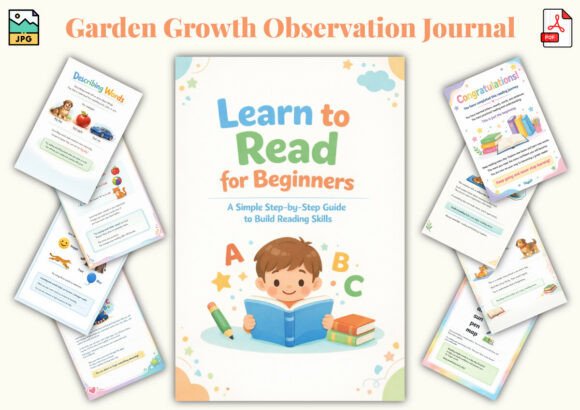
At its core, Learn to Read for Beginners is a 25-page workbook that walks through the early reading sequence in a deliberate, linear way. It begins with the alphabet in both uppercase and lowercase forms, then introduces letter sounds, blends sounds into simple CVC (consonant-vowel-consonant) words, and gradually builds toward short sentences and comprehension activities. The progression mirrors what many literacy specialists recommend: a systematic phonics foundation paired with sight word practice and opportunities for applying knowledge in context.
What stands out immediately is the design philosophy. The layout is intentionally clean and minimal, with large fonts and a soft pastel color palette. This is not a busy, overstimulating workbook. The goal appears to be reducing visual noise so that a developing reader can focus on the letters, sounds, and words themselves. Light illustrations and icons support meaning without distracting from the core task. For a beginner who may struggle with attention or visual clutter, this restraint can be a meaningful advantage.
The ebook also includes interactive worksheets, progress reflection pages, and a short story for comprehension practice. These elements give the reader a sense of accomplishment and a chance to apply emerging skills in a low-pressure setting. The consistency of design from cover to final page reinforces a predictable learning environment, which can be especially reassuring for young or anxious learners.
How It Compares with Other Approaches
When set alongside digital reading apps, Learn to Read for Beginners occupies a different space. Apps often use gamification, animations, and reward systems to maintain engagement. They can adapt to a child's pace and provide instant feedback. However, they also require screen time, and the constant stimuli can sometimes work against deep focus. A print-based workbook like this one offers a tactile, self-paced experience that encourages a learner to sit with a task, write, and reflect without flashing lights or audio cues. For families looking to reduce screen dependence or for situations where a child finds apps distracting, a workbook approach can be a grounded alternative.
Compared to more comprehensive phonics programs that span multiple volumes and include teacher guides, this ebook is intentionally brief. It covers the essentials but does not dive into advanced phonics patterns, complex digraphs, or multi-syllable words. It is not a full-year curriculum. Rather, it functions as an introductory tool that can be completed in several sessions, giving both teacher and learner a clear sense of progress before moving into a more extensive program. This makes it a good candidate for a summer refresher, a homeschool supplement, or a confidence-building first step.
Classroom reading materials often group children by level and use basal readers with accompanying workbooks. Those resources are designed for group instruction and may include teacher scripts, assessment tools, and differentiation suggestions. Learn to Read for Beginners is simpler. It assumes a one-on-one or small-group setting where an adult or older sibling can guide the learner through each page. It does not come with a detailed instruction manual, so the facilitator needs some comfort with basic phonics or a willingness to learn alongside the reader.
Strengths and Best-Fit Situations
This ebook shines in several specific contexts. For a parent who wants to spend 10 to 15 minutes a day working with a preschooler or kindergartner, the structure is manageable and clear. You can open to any page and understand immediately what skill is being taught. The large fonts and uncluttered pages also make it accessible for children who need visual simplicity—those with processing differences, dyslexia tendencies, or simply a low tolerance for busy pages.
Another strong use case is in adult literacy or ESL tutoring for absolute beginners. The maturity of the design (soft colors, clear typography, no childish cartoons) means that an older beginner does not have to use a book that feels babyish. The content is foundational, but the presentation is clean enough not to alienate an older learner. A tutor working with an adult who is just starting to read could move through the lessons at any pace, using the workbook as a structured conversation starter about letter sounds, word meanings, and simple sentences.
Homeschool families who follow a relaxed or eclectic approach often appreciate resources that are complete enough to guide them without dictating every moment of instruction. Learn to Read for Beginners fits that need. It provides a clear sequence and enough practice pages to reinforce each step, but it doesn't require hours of preparation. You can use it as a spine and supplement with library books, word games, or writing activities as desired.
Limitations and When to Consider Other Options
No single resource can meet every learner's needs, and it is important to be honest about where this workbook may fall short. For a child who needs extensive repetition or hands-on manipulatives, 25 pages may not be enough. Some beginners need to touch letter tiles, move magnetic letters, or trace sandpaper letters before they are ready to write. A workbook alone cannot replace that sensory engagement. If you suspect your learner benefits from a multi-sensory approach, you may want to pair this ebook with physical materials or look into a program like Orton-Gillingham or other structured literacy methods that incorporate movement and touch.
Another consideration is that the ebook does not include audio or pronunciation guides. For a parent or tutor who is unsure about correct letter sounds—especially the difference between a pure sound and a schwa—this can be a challenge. A digital app that pronounces each phoneme might offer more support in that area. Similarly, some workbooks now come with QR codes linking to video demonstrations, which this one does not appear to include. If you need built-in pronunciation support, you may need to supplement with a free online resource or a phonics reference.
Advanced learners or children who already know some letter sounds may find the pace too slow. The workbook begins at the very start—letter identification—and may not hold the attention of a child who is already reading simple words. For those ready to move beyond CVC words and into consonant blends, digraphs, and long vowels, this book will be too narrow. A more progressive series or a leveled reading library would better serve that stage.
Practical Factors in Deciding
Evaluating whether Learn to Read for Beginners is right for you depends on answering a few straightforward questions. First, what is the learner's current skill level? If they are truly at the beginning—unsure of letter names or sounds—this ebook aligns well. If they can already read a handful of short words, you might start in the middle or skip ahead, but the later pages are limited in number. Second, what is your role as the facilitator? Are you comfortable guiding reading practice, or do you want a program that tells you exactly what to say? If you need scripted instructions, you may find this workbook too open-ended. Third, what is your timeline? If you want a resource that can be completed in a few weeks and then set aside for the next level, this brevity is a strength. If you are looking for a yearlong program, this is only one piece of the puzzle.
Cost is another practical factor. As a digital download, the ebook is typically priced lower than a full print curriculum or a subscription to a learning app. There is no recurring fee, no in-app purchases, and no need to buy additional workbooks unless you want multiple copies. For a family testing the waters of formal reading instruction, the low commitment makes it an easy yes. You can try it, see how the learner responds, and then decide whether to invest in a more extensive program.
Printing is straightforward. The pages are sized for standard paper, and the design works in black and white if you want to save on color ink. The consistent layout means you can bind the pages or slide them into sheet protectors for reuse with dry-erase markers. That flexibility extends the life of the resource if you are working with more than one learner.
Making an Informed Choice
Every reading journey begins with a first step, and the value of a resource often depends on how well it fits the learner, the facilitator, and the context. Learn to Read for Beginners offers a clean, structured, and gentle introduction to reading that works especially well for those who prefer a print-based, visually simple, and paced approach. It compares favorably to apps and busy workbooks when focus and low stimulation are priorities, and it provides enough structure to guide a novice teacher or parent without overwhelming them. Its limitations—length, lack of audio support, and narrow scope—are not flaws so much as design choices that make it best suited for its intended purpose: an initial foundation.
For anyone evaluating early reading resources, the best approach is often to match the tool to the learner rather than trying to fit the learner to the tool. If you are looking for a warm, clear, and accessible starting point that respects the beginner's need for simplicity and success, this ebook is worth considering. If your learner requires more repetition, multi-sensory input, or advanced content, you can use this as a companion to other resources or look for a more comprehensive solution. Either way, understanding the tradeoffs helps you build a reading plan that actually works for the person holding the book.