1000 Burnout Recovery Prompts Canva: A Practical Guide to Using Prompts for Real Healing
Burnout doesn't arrive with a warning label. It creeps in through late nights, blurred boundaries, and the quiet erosion of energy you once took for granted. When you finally notice it, the exhaustion feels both mental and physical, and the path back to balance can seem unclear. This is exactly why tools like the 1000 Burnout Recovery Prompts Canva collection have gained attention. It offers a structured way to process emotional fatigue, rebuild self-care habits, and restore mental clarity through guided journaling. But having a set of prompts and using them effectively are two different things. Many people invest in resources like this only to see little change, not because the prompts lack value, but because of how they approach them. Let's walk through the common missteps and, more importantly, how to avoid them so you actually get the relief and renewal you're looking for.
What Exactly Is This Collection and Why Does It Matter?
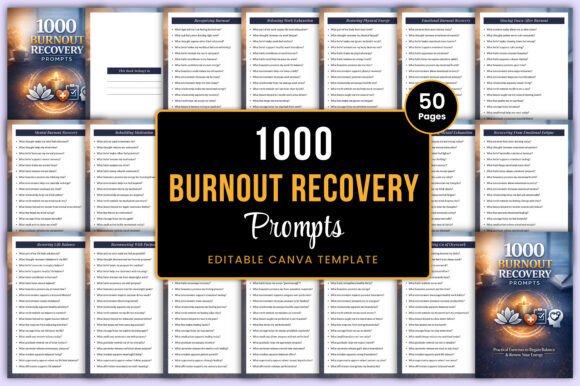
The 1000 Burnout Recovery Prompts Canva is a digital resource designed for anyone navigating stress, emotional exhaustion, or the lingering weight of overwork. It covers areas like self-care energy restoration, stress awareness, boundary setting, mindset shifts, and personal renewal. Each prompt is editable in Canva, meaning you can change the text, colors, fonts, and layout to match your personal style or brand. The final files come as high-quality, print-ready PDFs sized at 6x9 inches. That makes them ideal for burnout recovery journals, wellness planners, coaching programs, or printable products focused on healing.
What sets this apart from a generic journal is the volume and specificity. One thousand prompts gives you room to work through exhaustion methodically rather than running out of material after a week. But here's where people often go wrong: they treat the collection as a passive product rather than an active tool.
Mistake 1: Treating the Prompts Like a Quick Fix Instead of a Process
The most common misunderstanding is expecting immediate relief. Burnout recovery is not a linear event. It involves unpacking months or even years of accumulated stress, workload pressure, and emotional fatigue. When someone opens the 1000 Burnout Recovery Prompts Canva and writes one or two answers, they might feel a brief sense of clarity. But if they expect that single session to restore their energy, disappointment follows. Prompts are not a magic reset button. They are a mirror. They help you see what is actually happening beneath the surface of your exhaustion.
How to avoid this mistake: Approach the prompts as a practice, not a task. Set aside fifteen minutes a day, not hours. Let yourself write without editing or judging. The goal is not to finish all one thousand prompts quickly. It is to move through them slowly, noticing patterns in how you respond. If you find yourself rushing, pause. The prompts about stress awareness and emotional processing are designed to reveal triggers you might have been ignoring. Give them room to work.
Realistic example: Instead of writing "I feel tired" and moving on, spend a few minutes describing what tired feels like today. Is it heavy? Foggy? Restless? Noticing the nuance helps your brain process the experience rather than just labeling it.
Mistake 2: Ignoring the Customization Potential in Canva
This is one of the most overlooked details. The prompts come with an editable Canva link, which means you can change the text, colors, fonts, and layout. Many people download the PDF and start writing without ever opening the template. That is fine if the default design works for you. But if the colors feel harsh, the font feels cold, or the layout doesn't match your planning style, you are less likely to engage consistently.
How to avoid this mistake: Before you print or start journaling, take ten minutes inside Canva to make the template feel like yours. If you are a coach or creator using this for clients, match it to your brand colors. If you are using it personally, choose a calming color palette and a font that feels gentle to read. The process of customizing is itself a form of self-care. It signals to your brain that this is a space you are creating intentionally, not just a file you opened.
This small step directly affects usability and satisfaction. A journal that visually feels aligned with your intention for healing will invite you back day after day. A generic-looking page, on the other hand, can feel like just another task on your to-do list.
Mistake 3: Using Prompts Passively Without Real Reflection
It is easy to fall into the habit of writing surface-level answers. The prompt asks, "What drained your energy today?" and you write, "Work." That is technically an answer, but it does not help you restore anything. The real work happens when you go deeper. What specifically about work drained you? Was it the volume of tasks, the lack of control, the interpersonal tension, or the feeling that your efforts were invisible?
How to avoid this mistake: Treat each prompt as a conversation starter with yourself. If a question feels too big, break it into smaller parts. For example, if a prompt asks about boundaries, write about one specific situation where you said yes when you meant no. Describe what you felt in your body at that moment. Was there tension in your shoulders? Did your stomach tighten? Noticing physical sensations helps connect the emotional experience to your body, which is a key part of recovery.
This approach transforms the 1000 Burnout Recovery Prompts Canva from a simple list into a genuine therapeutic tool. The quality of your reflection matters far more than the quantity of prompts you complete.
Mistake 4: Overlooking Boundaries and Life Balance Prompts
Most people gravitate toward the emotional processing and self-care prompts first. That makes sense because those feel immediately relevant. But the sections on boundaries and life balance are where long-term recovery happens. Burnout is rarely just about working too hard. It is often about not knowing where to stop. If you skip the prompts that ask about priorities, workload distribution, and the habits that keep you overextended, you are likely to recover temporarily and then fall back into the same patterns.
How to avoid this mistake: Make a point to rotate through all sections, not just the ones that feel comfortable. The boundaries prompts might feel uncomfortable because they highlight where you have been giving too much of yourself. That discomfort is information. It tells you where change is needed. Use those prompts to map out one small boundary you can set this week. It could be as simple as not checking email after 7 p.m. or saying no to one non-essential request.
The mindset shifts and renewal prompts are equally important. They are not about toxic positivity. They are about deliberately choosing a perspective that supports recovery, such as recognizing that rest is productive and that your worth is not tied to your output.
Mistake 5: Not Checking the Format and Print Readiness Before Committing
If you are buying or downloading the 1000 Burnout Recovery Prompts Canva, especially for commercial use like coaching or printable products, it is essential to understand the format. The collection comes as a high-quality, print-ready 6x9 inches PDF. That is a standard size for journals and planners, but it is not the same as a full-letter size sheet. If you plan to print at home, make sure your printer settings match. If you are using the digital file on a tablet, check whether the 6x9 layout works with your preferred note-taking app or if you need to adjust the canvas size inside Canva before starting.
How to avoid this mistake: Before you purchase or download, confirm that the format aligns with how you intend to use it. If you are a creator selling wellness planners, the 6x9 size is ideal for professional-looking printed products. If you are a therapist or coach using it with clients, consider whether you want a digital fillable version or a printed booklet. The Canva editability gives you flexibility, but you need to know your end use case. For example, if you want to use the prompts on a phone or tablet, you might want to adjust the page size in Canva to a vertical screen ratio.
This step saves time and frustration. Nobody wants to buy a resource only to discover the layout doesn't suit their workflow.
What to Check Before You Decide or Use This Collection
Before you commit to using the 1000 Burnout Recovery Prompts Canva, ask yourself a few practical questions. First, are you ready to engage with emotional content? Some prompts will ask about stress triggers, emotional exhaustion, and workload pressure. That is the point, but it can feel raw. If you are in a very vulnerable state, consider whether you want to work through these alone or with a coach or therapist. The prompts are a tool, not a replacement for professional support.
Second, do you have a consistent time and place for journaling? A resource like this works best when it becomes part of a routine. Even ten minutes in the morning or before bed creates a container for processing. Without a routine, the prompts can feel like an overwhelming list rather than a supportive guide.
Third, if you are a creator or coach, think about how you will present this to others. The editable Canva template is a huge advantage because you can brand it, but make sure you understand the licensing terms for commercial use if you plan to sell or distribute the content. Clear communication with your audience about what the prompts address—burnout recovery, emotional balance, self-care, boundaries—sets proper expectations and builds trust.
Building a Sustainable Practice Around the Prompts
The real value of the 1000 Burnout Recovery Prompts Canva lies not in the number of prompts, but in how consistently and honestly you engage with them. Recovery from burnout is a gradual process of releasing stress, restoring energy, and rebuilding the habits that protect your well-being. The prompts give you a map, but you have to walk the path. That means showing up even on days when you do not feel like writing, especially on those days. It means using the sections on boundaries and mindset shifts even when they challenge you. And it means treating the customization feature not as a nice extra, but as a way to make the practice truly yours.
Whether you are using this for personal healing, as a coach supporting clients, or as a creator building wellness products, the same principle applies: the tool is only as effective as the intention behind it. Take the time to customize, reflect deeply, and rotate through all the prompt categories. That is how you move from just reading about burnout recovery to actually experiencing renewal.