Junior Money Master Workbook: Teaching Kids Financial Basics
Financial literacy is one of those life skills we often assume children will just pick up along the way. Yet many adults reach their twenties wishing someone had walked them through the basics earlier. The Junior Money Master Workbook aims to fill that gap, offering a structured, playful approach to money education for young learners. Whether you are a parent introducing allowance systems, a teacher building a classroom economy, or a homeschooler weaving math into real-world contexts, this resource provides a practical starting point.
What makes this workbook stand out is its balance between fun and function. It does not lecture children on fiscal responsibility. Instead, it invites them into a world where saving, spending, and goal-setting become natural parts of play. The result is a learning tool that feels more like an activity book than a lesson plan, which is precisely the point.
What the Workbook Offers
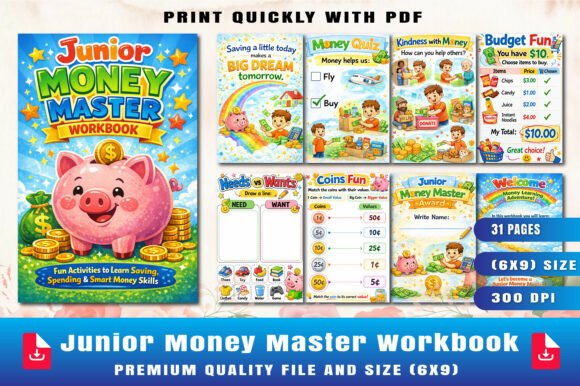
The Junior Money Master Workbook is a printable collection of 31 pages designed for children taking their first steps into money management. Each page measures 6 by 9 inches, making it easy to print, bind, or slip into a folder. The format is intentionally compact—manageable for small hands and convenient for parents or educators who need a portable resource.
Inside, you will find a mix of activities that move beyond simple counting exercises. Savings trackers and allowance charts give children a visual record of their progress, while needs-versus-wants exercises help them distinguish between essentials and extras. There are also pages dedicated to simple money math, role-play shopping scenarios, word searches, tracing prompts, coloring pages, and creative drawing activities. A goal-setting section and a reward certificate wrap things up, providing a sense of accomplishment and a tangible milestone.
The design leans heavily on kid-friendly aesthetics: colorful layouts, cute piggy bank illustrations, coin icons, stars, and charts that make each page feel inviting rather than intimidating. This matters because a child’s first exposure to financial concepts should feel like discovery, not homework.
Why Financial Literacy Matters Early
Research consistently shows that money habits form early. By age seven, many children have already developed attitudes about spending and saving that can persist into adulthood. Introducing concepts like budgeting, delayed gratification, and goal-setting during these formative years gives kids a foundation that serves them for life.
The Junior Money Master Workbook addresses this window of opportunity directly. Rather than abstract lessons, it offers concrete, repeatable activities. A child might color in a piggy bank each time they save a coin, or draw what they plan to buy after reaching a savings goal. These actions create mental anchors. Later, when that same child faces a real decision about spending versus saving, the memory of filling in a chart or earning a sticker may guide their choice.
For adults guiding the process, the workbook removes much of the guesswork. You do not need to be a financial expert or a trained educator to use it effectively. The structure is self-explanatory, and the activities require minimal preparation. Print a page, grab some crayons or a pencil, and you are ready to go.
Practical Applications Across Different Settings
One of the workbook’s strengths is its versatility. It works well in several environments, each with slightly different goals.
In the Home
Parents often struggle with how to talk about money without making it feel heavy or stressful. The workbook turns these conversations into shared activities. You might sit with your child after they receive their weekly allowance and help them fill out a savings tracker together. The role-play shopping pages let you practice decision-making in a low-stakes way—should they spend their pretend money on a toy or save it for a bigger item later?
The reward certificate at the end adds a ceremonial touch. When a child completes the workbook or reaches a savings goal, presenting a certificate gives them a sense of pride and closure. This simple gesture reinforces the idea that financial discipline has tangible rewards.
In the Classroom
Teachers looking for engaging math or social studies supplements will find the workbook aligns well with early elementary curricula. The money math pages support numeracy skills, while the needs-versus-wants exercises tie into broader lessons about resources and decision-making. Because the workbook is printable, you can distribute individual pages as needed without requiring students to purchase a full book.
Group activities also benefit. A class might run a mock store using the role-play pages, with some students acting as shopkeepers and others as customers. This collaborative approach introduces concepts like exchange, scarcity, and value in a hands-on, memorable format.
In Homeschooling
Homeschooling families often need resources that are both educational and flexible. The Junior Money Master Workbook fits neatly into a unit on practical life skills. You can pace it according to your child’s interest—spending a week on savings trackers or revisiting the goal-setting pages periodically throughout the year. The lack of grade-level labels means the workbook can be used with siblings of different ages, each working at their own pace.
Key Strengths and Notable Qualities
Several characteristics make this workbook particularly effective for its intended audience.
Simplicity without condescension. The activities are straightforward enough for young children to grasp, yet they avoid talking down to them. The language is clear, the instructions are minimal, and the focus stays on doing rather than listening.
Visual engagement. The colorful layouts and cute illustrations serve a purpose beyond decoration. They cue children into different sections and make tracking progress feel playful. A child who might resist a plain spreadsheet will eagerly color in a chart shaped like a piggy bank.
Built-in progression. The workbook moves from basic concepts like identifying coins to more complex ideas like setting goals and making trade-offs. This natural progression allows children to build confidence gradually. Early pages feel easy and rewarding, which motivates them to tackle later, slightly harder activities.
Low barrier to entry. Being a printable resource means you can start immediately. There is no shipping delay, no risk of running out of pages, and no need to buy multiple copies for multiple children. Print what you need, when you need it.
Observations from Real Use
In practice, the workbook tends to work best when adults participate alongside the child. A parent or teacher who sits down and works through a page together adds context and encouragement. The activities themselves are designed for independent use, but the richest learning often happens in the conversation that follows: Why did you decide to save for the soccer ball instead of buying candy? What would happen if you spent all your money today?
One particularly effective page is the needs-versus-wants exercise. Children are presented with various items and asked to sort them. This simple categorization builds critical thinking. Over time, kids start applying the same logic to real-life situations, asking themselves whether a desired item is something they need or something they merely want. That questioning habit is valuable far beyond childhood.
The savings trackers also tend to be a hit. Children enjoy seeing their progress visually. Each completed tracker becomes a small record of discipline and achievement. Some families laminate the trackers and reuse them with dry-erase markers, extending the workbook’s lifespan beyond a single use.
Practical Considerations
When evaluating whether the Junior Money Master Workbook fits your needs, consider the following.
Age range. The workbook suits children roughly between ages four and eight, though older or younger children may still enjoy select pages. If you have a child on the younger end, you might focus on the coloring and tracing pages first. Older children can handle the money math and goal-setting sections independently.
Printing quality. Because the workbook is provided as JPG and PDF files, print quality depends on your printer and paper. For best results, use a color printer and heavier paper if you plan to write or color on both sides. The 6-by-9-inch size prints well on standard letter paper with some trimming, or you can print at full size and fold the pages.
Reusability. Some pages are single-use by nature, like the coloring sheets. Others, such as the savings trackers, can be used repeatedly if you laminate them or place them in sheet protectors. Consider your child’s learning style and how often you want to revisit certain activities.
Supplementing with real practice. The workbook is most effective when paired with real-world money experiences. Give your child a small allowance, let them make spending decisions, and use the workbook pages to reflect on those choices. The workbook provides the framework; real practice provides the context.
Final Thoughts
The Junior Money Master Workbook offers a thoughtful entry point into financial literacy for young children. It takes abstract concepts and turns them into concrete, enjoyable activities. For parents, teachers, homeschoolers, and caregivers, it removes the intimidation factor from teaching money basics and replaces it with structure, color, and a bit of fun.
Financial education does not need to wait until high school or college. Starting early, with the right tools, gives children a foundation that lasts. This workbook is one such tool—simple, practical, and designed with the learner in mind.