The OCD Workbook: A Practical Guide to Managing Obsessions and Finding Balance
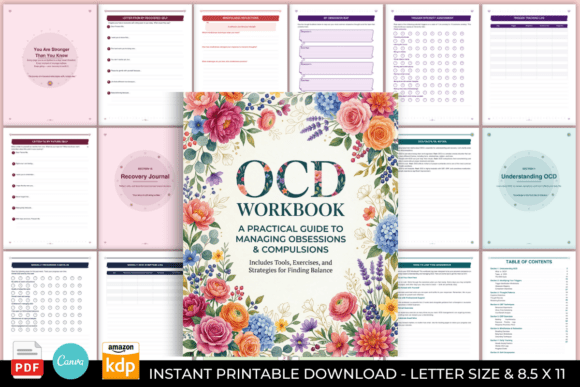
Living with obsessive-compulsive disorder often feels like being caught in a loop that repeats itself no matter how hard you try to step out. Intrusive thoughts arrive without warning, anxiety builds, and the urge to perform a compulsion becomes overwhelming. For a brief moment, the ritual offers relief — but the cycle soon begins again. Breaking that pattern requires more than willpower; it requires structured tools, a clear understanding of how OCD operates, and a safe space to practice new responses. That is precisely what the OCD Workbook provides. This comprehensive 118-page resource, rooted in evidence-based approaches such as Cognitive Behavioral Therapy (CBT) and Exposure and Response Prevention (ERP), offers a practical, compassionate path toward reclaiming peace of mind.
For adults navigating the complexities of obsessive thoughts and compulsive behaviors — whether you are a professional managing a demanding career, a creator seeking mental clarity, a busy parent, or an entrepreneur balancing multiple responsibilities — this workbook serves as both an educational guide and a hands-on tool. It helps you name what you are experiencing, map out your triggers, and gradually reduce the power that intrusive thoughts hold over your daily life. Rather than offering vague advice, it walks you through concrete exercises that build resilience over time.
What the OCD Workbook Offers and Why It Matters Today
The OCD Workbook is not just another self-help book filled with general tips. It is a structured resource designed to help you understand the specific mechanics of your own OCD cycle. The first section dives deep into what OCD actually is — moving beyond common misconceptions to explain the nature of obsessions and compulsions in clear, accessible language. You learn how triggers lead to anxiety, how compulsions provide only short-lived relief, and most importantly, how to interrupt that loop at key points.
What makes this workbook particularly relevant right now is the growing recognition that mental health support must be both accessible and customizable. In a world where therapy waitlists are long and professional help can be expensive, many adults are looking for reliable, evidence-based resources they can use on their own schedule. The OCD Workbook fills that gap. It offers a professional, non-judgmental space where you can work through your experiences at your own pace, without pressure or judgment. Whether you are dealing with contamination fears, checking compulsions, intrusive thoughts about harm or relationships, or more abstract obsessive patterns, the workbook includes recognition worksheets — starting on page 8 — that help you identify and name your specific themes.
Why Structured Workbooks Are Gaining Attention in Mental Health
There is a noticeable shift happening in how people approach mental health. The old model of simply attending weekly therapy sessions and hoping for gradual improvement is being supplemented by more proactive, skill-building approaches. People want tools they can use between sessions, resources that teach them practical techniques, and formats that fit into modern, busy lifestyles. Workbooks like this one are part of a broader trend toward self-directed learning and empowerment in mental health care.
This shift is driven by several factors. First, there is greater awareness that managing OCD is not about eliminating all intrusive thoughts — that is neither realistic nor necessary — but about changing your relationship with them. Second, the rise of remote work and digital life has blurred boundaries between personal time and professional demands, making it harder for many to maintain mental equilibrium. The OCD Workbook addresses these realities directly. It acknowledges that you may be navigating OCD while also holding down a job, raising a family, or building a business, and it provides exercises that fit into real life rather than requiring you to pause everything.
Third, there is a growing preference for resources that are grounded in science but presented in human terms. People are tired of jargon-heavy texts that feel inaccessible. They want something that respects their intelligence without assuming clinical expertise. This workbook strikes that balance. It explains concepts like exposure hierarchies and cognitive restructuring in plain language, then gives you the worksheets to apply them immediately.
How the Understanding of OCD Has Evolved
Not long ago, OCD was often misunderstood as simply being overly neat or excessively cautious. Many people dismissed it as a quirky personality trait rather than a serious condition that can significantly impair daily functioning. The past two decades have brought a much deeper understanding. We now know that OCD is a complex disorder involving specific brain circuits, that it often co-occurs with anxiety and depression, and that it manifests in a wide variety of themes — many of which have nothing to do with cleanliness or order.
This evolution in understanding has changed how treatment is approached. The gold standard today is ERP, which involves gradually confronting feared situations without performing compulsions, while building distress tolerance over time. CBT complements this by addressing the underlying thought patterns that fuel the cycle. The OCD Workbook integrates both approaches into a cohesive system. It does not ask you to jump into the deep end right away. Instead, it starts with education and identification, moves into trigger mapping and obsession tracking, and then guides you through structured exposure exercises that you can tailor to your own comfort level.
Another important shift is the recognition that OCD is not a one-size-fits-all condition. Two people with OCD can have completely different experiences. One might struggle with intrusive images of harming a loved one, while another might spend hours arranging objects symmetrically. The workbook acknowledges this diversity by including multiple types of OCD recognition worksheets. It gives you the language to describe your own experience accurately, which is often the first step toward feeling less isolated and more empowered.
Practical Implications for Professionals, Creators, and Everyday Readers
If you are a professional juggling deadlines and meetings, intrusive thoughts can be more than distressing — they can interfere with concentration, decision-making, and productivity. The OCD Workbook helps you identify the specific triggers that arise in work settings, whether that is fear of making a mistake, needing to check emails repeatedly, or avoiding certain tasks due to anxiety. By mapping these patterns, you can begin to develop targeted strategies that reduce the time and energy lost to compulsions.
Creators — writers, artists, designers, musicians — often face a unique challenge. The creative process requires a certain openness to uncertainty and imperfection, which can be particularly difficult when OCD demands certainty and control. The workbook offers exercises that help you separate your creative voice from the critical, obsessive voice. It encourages you to practice tolerating the discomfort of unfinished work, ambiguous feedback, or imperfect outcomes, which is essential for sustaining a creative practice over the long term.
For entrepreneurs and business owners, the stakes are high. Running a business involves constant decision-making, risk assessment, and adaptability. OCD can amplify doubts and lead to excessive checking, over-planning, or avoidance of necessary risks. The practical tools in this workbook — particularly the trigger identification worksheets and obsession mapping exercises — help you recognize when OCD is influencing business decisions and how to respond differently. Instead of getting stuck in analysis paralysis, you learn to take action despite the discomfort.
Everyday readers who are not necessarily in high-pressure roles also benefit enormously. OCD affects relationships, self-esteem, and the ability to enjoy simple moments. The workbook includes exercises that help you clarify your values and align your actions with what truly matters to you, rather than what OCD demands. This value-based approach is one of the most empowering aspects of the resource. It shifts the focus from fighting symptoms to building a meaningful life.
What You Will Find Inside the OCD Workbook
The workbook is organized into clear sections that build on each other. Section 1 provides the foundation: understanding the OCD cycle, identifying the types of OCD you may be experiencing, and learning how obsessions and compulsions interact. Section 2 moves into practical application with trigger identification worksheets that help you pinpoint both external events — such as specific places, people, or situations — and internal events like thoughts or bodily sensations that spark your symptoms.
The obsession mapping exercise is particularly useful. It guides you to visually track how a single intrusive thought can snowball into a cascade of anxiety, avoidance, and compulsive behavior. By laying this out on paper, you gain a clearer perspective on where you can intervene most effectively. You also begin to see the hidden rules your OCD follows — the unspoken "if-then" logic that drives so much of the cycle. Naming these rules is a powerful step because it moves them from automatic, unconscious patterns to conscious, addressable habits.
Later sections guide you through building exposure hierarchies, practicing response prevention, and developing a personalized maintenance plan. The entire 118-page resource is designed to be used progressively, but you can also dip into specific sections as needed. Many users find it helpful to revisit the trigger identification worksheets periodically, as new triggers can emerge as old ones lose their power.
How to Use the OCD Workbook in Your Daily Life
One of the strengths of this resource is that it does not require a massive time commitment to see results. Even spending fifteen minutes a day with a single worksheet can create meaningful shifts in awareness and behavior. The key is consistency rather than intensity. You might start by reading the educational content in Section 1 over a few days, then move to the trigger identification worksheets, spending a week or two simply noticing and recording your triggers without trying to change anything yet.
When you feel ready to move into exposure work, the workbook provides a framework for designing exercises that are challenging but not overwhelming. For example, if your OCD involves contamination fears, you might start with touching a doorknob in your own home and waiting thirty seconds before washing your hands. Over time, you increase the duration or the difficulty. The workbook gives you the structure to track your progress, note your anxiety levels, and reflect on what you are learning.
It is also worth using the workbook alongside professional support if that is available to you. Therapists who specialize in OCD often recommend workbooks like this to reinforce what is covered in sessions. But even if you are working through it independently, the structured format and evidence-based foundation make it a reliable guide.
Realistic Recommendations for Lasting Progress
No workbook can eliminate OCD overnight, and this one does not promise instant transformation. What it does offer is a realistic, step-by-step pathway toward reducing the grip that obsessions and compulsions have on your life. Progress often happens in small increments. You might notice that a trigger that used to send you into a spiral now causes only mild discomfort, or that a compulsion you felt compelled to perform has become optional. These small wins accumulate over time.
It is also important to approach the workbook with self-compassion. There will be days when exercises feel too hard or when you fall back into old patterns. That is normal. The workbook is designed to be revisited. You can repeat sections, redo worksheets, and track your growth over months. The goal is not perfection but gradual, sustainable change.
For readers who want to support a loved one with OCD, the workbook can also serve as a resource for understanding what they are going through. The clear explanations of the OCD cycle and the types of OCD can help family members and friends offer more informed, patient support.
Taking a courageous step toward a calmer mind does not mean you have to have everything figured out. It means choosing to engage with a tool that respects your experience, grounds itself in science, and gives you something practical to do between moments of struggle. The OCD Workbook is that tool — a structured, compassionate companion for anyone ready to break the cycle, manage obsessions, and reclaim the peace of mind that OCD has been stealing.