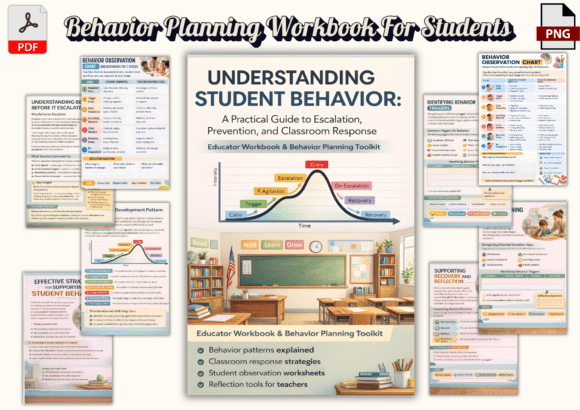
Understanding Student Behavior Workbook: A Practical Guide to Proactive Classroom Management
Every teacher knows the feeling. A lesson is flowing well, students are engaged, and then a subtle shift in energy signals something is off. A student becomes restless, another withdraws, and a third begins to challenge instructions. In that moment, having a structured way to interpret what is happening can make all the difference. The Understanding Student Behavior Workbook is designed to bridge that gap between observation and effective action. Instead of reacting in the moment with guesswork, this 17-page printable resource provides a clear framework for recognizing patterns, identifying triggers, and responding in ways that support long-term student success.
This workbook is not a theoretical overview of child psychology. It is a hands-on tool built for real classroom environments. Whether you work with general education students, those in special education, or learners in alternative settings, the workbook helps you move from feeling overwhelmed by challenging behavior to feeling prepared and informed.
What the Understanding Student Behavior Workbook Contains and Why It Matters
The workbook is organized into sections that mirror the natural progression of understanding and managing behavior. It starts with an introduction to student behavior and escalation patterns, then moves through visual guides, observation sheets, and planning pages. The structure reflects how effective classroom management actually works: you observe, you analyze, you plan, and you respond consistently over time.
The visual guide to the behavior development cycle is particularly valuable. Many educators understand that behavior escalates, but having a visual reference helps you identify exactly where a student is in that cycle. This clarity allows you to choose an appropriate intervention before the situation intensifies. The behavior observation worksheets give you a systematic way to record what you see without relying on memory alone. Over time, these records reveal patterns that might otherwise go unnoticed.
The workbook also includes early warning sign identification tools, which are essential for proactive management. By learning to spot subtle indicators before a full escalation occurs, you can redirect energy early. The classroom prevention strategy planners and trigger identification worksheets help you connect what you observe with practical adjustments to your environment or instruction. Finally, the escalation response strategies and reflection pages ensure that you are not only managing incidents but also learning from them.
Integrating the Workbook into Your Daily Classroom Process
The workbook fits naturally into three key phases of classroom management: before incidents occur, during moments of escalation, and after events for reflection and planning. Understanding how to use it in each phase makes it a versatile resource rather than something you pull out only in crisis.
Before Behavior Challenges Arise: Prevention and Proactive Planning
The most effective classroom management happens before a problem emerges. The workbook supports this proactive approach through its prevention strategy planners and trigger identification worksheets. Start by using the early warning sign tools during your regular observation of students. Spend a few minutes each week noting any changes in behavior, even subtle ones. Over time, you will build a picture of which students are more vulnerable to escalation and under what circumstances.
Use the classroom prevention strategy planners to adjust your routines, seating arrangements, or instructional pacing. For example, if you notice a student becomes agitated during transitions, you can plan a specific strategy for that part of the day. The trigger identification worksheets help you go deeper: is the trigger academic frustration, social dynamics, sensory overload, or something else? By identifying triggers systematically, you can make targeted changes that reduce the likelihood of escalation altogether.
This phase also benefits from collaboration. Share the observation worksheets with a school psychologist or behavior specialist to get additional perspective. The workbook becomes a common language that helps multiple adults coordinate their support for a student.
During Escalation: Staying Calm and Informed
When behavior does escalate, the workbook provides structured response strategies that help you stay grounded. The escalation response strategies section offers practical approaches for different stages of the behavior cycle. Rather than relying on instinct alone, you can reference the framework to decide whether to redirect, offer choices, provide a calming break, or use a more structured intervention.
The key here is preparation. If you have already used the observation and planning sections of the workbook, you will have a personalized response plan ready. You will know which strategies tend to work for a particular student and which tend to escalate the situation further. This familiarity reduces your own stress and allows you to respond with consistency, which is critical for helping students de-escalate.
File formats matter here. The high-quality PDF and individual PNG files mean you can print specific pages to keep in a binder, post them in a calming corner, or access them digitally on a tablet. Having quick reference sheets near your desk can be invaluable in a tense moment.
After the Incident: Reflection and Long-Term Growth
The reflection and educator planning pages are where the workbook becomes a tool for professional growth. After an incident, take time to complete a reflection page while the details are fresh. Ask yourself what worked, what did not, and what you might try differently next time. This is not about assigning blame but about building your own capacity to respond effectively over time.
These reflections also create a record you can refer to later. If you notice a pattern across multiple incidents, you can revisit the trigger identification worksheets and adjust your prevention strategies. The workbook supports an iterative process: observe, plan, respond, reflect, refine. This cycle is the foundation of consistent, effective classroom management.
Practical Implementation Tips for Educators
Getting the most out of the Understanding Student Behavior Workbook requires more than just printing it. Here are practical ways to integrate it into your existing workflow without adding overwhelming extra work.
- Start with one student. If you manage a full classroom, begin by using the observation and trigger identification worksheets for one student who presents consistent challenges. Once you see progress, expand the approach to others. This keeps the process manageable.
- Set a weekly observation time. Dedicate 10 minutes each week to complete a brief observation sheet for key students. Consistency matters more than volume. Regular small observations are more useful than occasional deep dives.
- Pair the workbook with existing tools. If your school uses a behavior tracking system or a specific intervention framework, use the workbook as a companion resource. The observation worksheets can feed into your school's data collection, and the reflection pages can inform meetings with support staff.
- Use the PNG files for digital integration. The individual PNG files allow you to insert specific worksheets into a digital planner, Google Doc, or shared drive. This is especially useful if you collaborate with a team or prefer to keep records electronically.
- Create a behavior support binder. Print the most frequently used pages and organize them in a binder with tab dividers. Include a section for each student you are actively supporting. Having a physical resource you can flip through quickly can be more intuitive than navigating digital files during a busy school day.
Who Benefits Most from This Resource
The workbook is designed for a broad range of education professionals, each of whom will find different aspects most useful. Classroom teachers benefit from the practical prevention and response strategies that fit into daily routines. School psychologists and behavior intervention specialists can use the detailed observation and trigger identification pages as part of formal assessments or intervention planning. Special education teachers will appreciate the structured approach to understanding behavior that may be linked to specific disabilities. Homeschool educators, who often manage multiple roles, can use the workbook to build consistent routines in a home learning environment.
Teacher training programs also find value in this resource. It provides a concrete structure for discussing behavior management with new teachers, giving them a framework they can carry into their own classrooms. The visual guides and worksheets make abstract concepts tangible, which is especially helpful for educators who are early in their careers.
Making the Most of a Digital Download Format
Because the workbook is a digital download, you have flexibility in how you access and use it. The high-quality PDF is ideal for printing on standard 6 x 9 inch paper, which fits easily into a binder or notebook. The individual PNG files allow for more creative use: you can upload them to note-taking apps, import them into a digital planning tool, or even project specific pages on a screen during a team meeting.
To keep the resource organized long term, create a dedicated folder on your computer or cloud storage. Save the PDF as a master copy and use the PNG files for specific tasks. If you print the pages, consider laminating frequently used sheets like the escalation response strategies so they hold up over the school year.
Building Consistency Over Time
The true power of the Understanding Student Behavior Workbook lies in consistent use over weeks and months. Behavior change does not happen overnight, and neither does building your own skills as a responsive educator. By committing to the observation, reflection, and planning cycle, you develop a deeper understanding of the students you serve. You become more attuned to early warning signs, more confident in your responses, and more effective at creating a classroom environment where all students can succeed.
This resource is not a quick fix. It is a structured companion for the ongoing work of building positive relationships and managing a complex classroom. For educators who are serious about moving from reactive discipline to proactive support, the workbook provides a reliable framework that grows with you over time.