The Science Investigation Workbook: Fostering Curiosity and Critical Thinking in the Next Generation
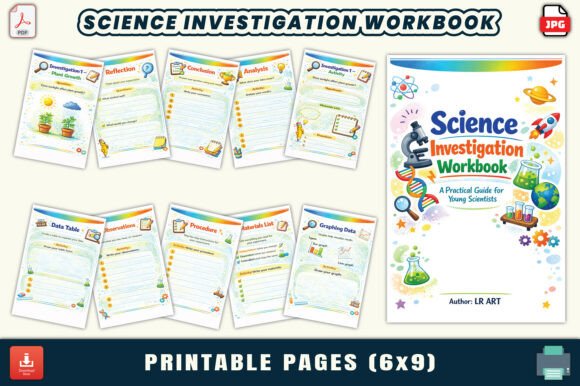
In an era defined by information abundance and rapid technological change, the ability to think critically, ask meaningful questions, and engage in systematic inquiry has never been more valuable. While digital tools and screen-based learning dominate much of modern education, there is a growing recognition that tangible, hands-on experiences remain irreplaceable for developing deep understanding. The Science Investigation Workbook — a 30-page printable resource in JPG and PDF formats — sits at the intersection of these trends, offering a structured yet flexible framework for learners to engage with the scientific method in a tactile, reflective way. This article explores how this workbook addresses evolving educational needs, fits into broader shifts in learning and consumer behavior, and why it is capturing the attention of educators, parents, and creators alike.
The Resurgence of Inquiry-Based Learning
Educational paradigms have shifted significantly over the past decade. Traditional models that emphasized memorization and passive absorption of facts are giving way to approaches that prioritize curiosity, exploration, and student agency. Inquiry-based learning — where learners drive their own investigations by posing questions, designing experiments, and drawing conclusions — has become a cornerstone of modern STEM and STEAM education. The Science Investigation Workbook is purpose-built for this methodology. It guides users step by step through the scientific method, from formulating a hypothesis to recording data and reflecting on outcomes. This structure does not merely teach science content; it teaches how to think like a scientist — a skill that transcends disciplines and prepares learners for a world that demands adaptability and evidence-based reasoning.
This trend is not isolated to classrooms. Homeschooling families, microschools, and informal learning environments have embraced inquiry-based resources because they align with the need for personalized, self-directed education. The workbook’s print-friendly design and ready-to-use format make it accessible to anyone, regardless of setting. Its 6-by-9-inch pages are easy to handle, and the inclusion of both JPG and PDF files ensures compatibility across devices and printing preferences. For professionals in the education space — curriculum designers, tutors, content creators — this kind of resource represents a shift toward modular, adaptable tools that empower learners rather than dictate outcomes.
Why Hands-On Science Matters More Than Ever
Despite the proliferation of virtual labs and interactive simulations, there is mounting evidence that physical experimentation enhances conceptual understanding and retention. Handling materials, observing real-world changes, and grappling with unexpected results foster cognitive engagement that digital interfaces often fail to replicate. The Science Investigation Workbook integrates five hands-on investigations spanning plants, ice, magnets, and other accessible phenomena. These activities are deliberately simple, using everyday items, so that the focus remains on the process of investigation rather than on elaborate setups.
Moreover, the workbook includes safety guidelines and vocabulary sections, which are essential for building responsible scientific habits from an early age. For entrepreneurs and marketers in the educational product space, the emphasis on safety and vocabulary reflects a broader consumer demand for resources that are both rigorous and parent-friendly. Parents and educators are increasingly scrutinizing learning materials for their ability to promote critical thinking while minimizing risk. This workbook addresses those concerns directly, making it a trustworthy addition to any learning library.
Responding to Changing Workflows and Expectations
The landscape of education and parenting has changed dramatically. Remote and hybrid learning models have become commonplace, and the lines between school and home have blurred. In this context, resources that are printable, portable, and self-contained hold distinct advantages. The Science Investigation Workbook meets these expectations by offering a complete, standalone experience. Teachers can assign pages for classroom use or send them home for independent practice. Parents can pull out an investigation on a weekend afternoon without needing to search for supplementary materials. The data recording tables, graph pages, and reflection sections are designed to be intuitive, reducing the cognitive load on both instructors and learners.
From a content strategy perspective, the workbook’s structure also supports differentiated instruction. Learners can progress at their own pace, revisit sections, and build confidence over time. This flexibility is particularly valuable in mixed-ability settings, where one-size-fits-all approaches often fall short. For creators and marketers, this kind of adaptable resource has high perceived value because it serves multiple use cases — classroom enrichment, homeschool curriculum, revision aid, or even a fun educational gift.
Designed for Real-World Scientific Thinking
At the heart of the Science Investigation Workbook is a commitment to the scientific method as a living practice. The workbook includes dedicated worksheets for each stage of investigation: asking questions, forming hypotheses, conducting experiments, recording observations, analyzing data, and drawing conclusions. The inclusion of graph pages and analysis sections pushes learners beyond qualitative description into quantitative thinking. This is crucial because data literacy is one of the most sought-after competencies in the 21st-century workforce. By engaging with tables and graphs in a low-stakes, hands-on context, learners build intuitions about evidence and interpretation that will serve them in any data-rich field.
The reflection sections are particularly noteworthy. They prompt learners to consider what went well, what could be improved, and what new questions emerged. This metacognitive layer is often missing from commercial science kits, which tend to focus on execution rather than reflection. The workbook’s design prioritizes the iterative nature of science — the understanding that every experiment leads to new questions, not final answers. For professionals in content creation or educational technology, this emphasis on reflection and iteration represents a best practice in resource design that aligns with deeper learning goals.
Practical Applications Across Diverse Settings
The versatility of the Science Investigation Workbook is one of its strongest attributes. In formal classrooms, it can serve as a supplement to existing curricula, providing structured opportunities for hands-on practice. Teachers can use the bonus experiment design pages to challenge advanced students, while the vocabulary section supports English language learners and struggling readers. In homeschool environments, the workbook offers a ready-to-use science block that requires minimal preparation from parents. For after-school programs and science clubs, the investigations are engaging enough to hold attention while being short enough to fit within a session.
From a consumer perspective, the educational gift market has grown substantially, driven by parents and relatives who want to give presents that are both entertaining and meaningful. The Science Investigation Workbook fits this niche perfectly. Its high-resolution pages and professional layout make it feel like a premium product, while its low-cost format (digital files for self-printing) offers exceptional value. For creators and marketers, this represents an opportunity to reach an audience that is actively searching for screen-free, skill-building activities. The workbook’s alignment with STEM education trends and its ready-to-print convenience make it a strong contender in the digital product marketplace.
Connecting to Broader Developments in Education and Consumer Behavior
The rise of the Science Investigation Workbook is not an isolated phenomenon. It reflects several larger trends that are reshaping how people learn, teach, and consume content. First, there is a growing skepticism toward passive screen time and a corresponding demand for active, tangible experiences. Parents and educators are seeking resources that require hands-on involvement and cognitive effort, not just swiping and tapping. Second, the homeschooling movement continues to expand, with more families choosing to take direct responsibility for their children’s education. This has created a robust market for high-quality, print-based curricula and supplements that are easy to implement without formal training.
Third, the gig economy and the rise of independent creators have lowered the barrier to entry for producing niche educational materials. Entrepreneurs and designers can now create resources like this workbook and distribute them globally with minimal overhead. The combination of JPG and PDF formats in this product is a savvy choice, as it maximizes compatibility and allows buyers to print individual pages as needed. This kind of flexibility is increasingly expected by savvy consumers who value customization and control.
Finally, there is a broader cultural shift toward developing future-ready skills — critical thinking, problem-solving, adaptability, and collaboration. The workbook directly cultivates these capabilities by requiring learners to hypothesize, test, record, and reflect. In a world where artificial intelligence and automation are changing the nature of work, the ability to ask the right questions and evaluate evidence is more valuable than ever. The workbook, by grounding learners in the scientific method, contributes to a foundation that extends far beyond science class.
Why People Are Paying Attention to This Resource
The Science Investigation Workbook has gained attention because it solves a real problem: how to make scientific inquiry accessible, structured, and enjoyable without requiring expensive equipment or extensive preparation. It appeals to busy teachers who need ready-made resources, to conscientious parents who want to provide enriching experiences at home, and to creators who see the potential for a scalable, high-value digital product. The combination of 30 beautifully designed pages, clear formatting, and a well-thought-out pedagogical sequence makes it stand out in a crowded market of educational printables.
Moreover, the workbook taps into a deep-seated desire for meaningful engagement. In an age of distraction, resources that ask learners to slow down, observe carefully, and think systematically are increasingly rare and increasingly valued. The emphasis on safety guidelines and vocabulary also signals a level of care that resonates with quality-conscious buyers. For marketers and content strategists, this workbook exemplifies how to build trust through thoroughness and user-centered design.
Conclusion: A Tool for Cultivating Lifelong Scientific Habits
The Science Investigation Workbook is more than a collection of worksheets — it is a scaffold for developing a scientific mindset. In a time when the ability to evaluate evidence, ask probing questions, and learn from failure is paramount, resources that support these skills are invaluable. Whether used in a classroom, a living room, or a community center, this workbook empowers learners to take ownership of their investigations and discover the joy of figuring things out. For professionals, creators, and educators looking to stay ahead of the curve in the evolving landscape of learning, this workbook represents a practical, thoughtful, and timely tool. By combining structured guidance with open-ended exploration, it equips the next generation with the habits of mind that will serve them for a lifetime.