30 Days of Calm – Guided Journal
Some mornings feel like you are already behind before you have even had coffee. The phone buzzes, notifications stack up, and your mind starts racing through the day's obligations before you have taken a single breath. That is exactly where the 30 Days of Calm – Guided Journal steps in. It is not a planner for appointments or a to-do list in disguise. It is a quiet space designed to help you slow down, notice what is happening inside, and build a sense of steadiness that does not depend on everything going right around you.
What makes this journal different from other mindfulness tools is how it connects what you feel with what you can actually do about it. Instead of vague prompts like "What are you grateful for?" it walks you through why your nervous system reacts the way it does and gives you grounded techniques to work with that reaction. The result feels less like homework and more like a conversation with someone who understands that life is messy and calm is not about escaping it, but learning how to move through it with more awareness.
When work feels like it never stops
If you have ever shut your laptop at the end of the day only to realize your shoulders are up by your ears and you have not taken a real break in hours, you know how easy it is to let stress become background noise. The 30 Days of Calm – Guided Journal is particularly useful for people who spend most of their day in front of screens, juggling deadlines, meetings, and the constant ping of messages.
One of the workbook's strengths is that it acknowledges digital overwhelm head-on. It offers reflection prompts that help you notice how your attention gets scattered and gives you small, realistic ways to reclaim focus without going off the grid completely. For someone working in a fast-paced environment, even five minutes with the journal during lunch or right after work can shift the way the rest of the evening feels. Instead of carrying the tension from the office into dinner or time with family, you start to create a boundary that your mind recognizes.
For anyone who has tried meditation and struggled
Let us be honest. Sitting still with your eyes closed and trying to clear your mind does not work for everyone. Some people feel restless, bored, or even more anxious when they try traditional meditation. The 30 Days of Calm – Guided Journal avoids that problem entirely by approaching mindfulness through writing and reflection rather than silence and stillness.
If you are someone whose mind works better when your hands are busy or when you are processing thoughts on paper, this journal feels natural. The exercises on breathing and grounding are embedded into the prompts, so you learn them by doing rather than by being told. Over thirty days, you begin to notice patterns in your thinking that you might have missed before. That tendency to catastrophize small setbacks, the way your breathing changes when you feel pressure, the physical signals your body sends before you even realize you are stressed. The journal trains you to catch these moments earlier, which is the first real step toward regulating your emotions rather than reacting to them.
Parents trying to hold it together
Parenting comes with constant low-level stress that rarely gets addressed because there is always someone else who needs something first. The 30 Days of Calm – Guided Journal works well for parents who need a structured way to check in with themselves without requiring a lot of time or a quiet house. You can use it during nap time, while waiting in the car during soccer practice, or even as part of a wind-down ritual after the kids are in bed.
The emotional awareness exercises are especially valuable here. When you are exhausted and overwhelmed, it is easy to snap at your partner or your children and then feel guilty about it afterward. The journal helps you build a habit of recognizing your emotional state before it reaches that tipping point. Over time, that awareness translates into calmer responses and more patience, not because you are trying harder, but because you are giving your nervous system the chance to reset regularly.
Students and young professionals figuring things out
Being in your twenties or thirties often means navigating uncertainty, whether that is finishing school, starting a career, moving to a new city, or figuring out relationships. The 30 Days of Calm – Guided Journal offers a framework for processing that uncertainty without needing to have everything figured out.
The neuroscience-based mini lessons are a big draw here. Understanding why your brain reacts with anxiety when you face the unknown makes the experience less scary. Instead of feeling broken or weak, you start to see your reactions as natural mechanisms that you can work with. The journal teaches this in a way that feels accessible, not academic. You do not need a background in psychology to benefit from it. You just need to be willing to show up and write for a few minutes each day.
For young professionals, the journal can also serve as a tool for setting healthier boundaries around work. The prompts encourage reflection on how you spend your time and attention, which naturally leads to questioning whether your current routines are serving you or draining you.
Creative people looking for clarity
Creativity and mental clutter do not mix well. If you are a writer, artist, designer, or anyone whose work depends on generating ideas, you know that stress and overthinking can block the flow completely. The 30 Days of Calm – Guided Journal helps clear that internal noise by guiding you through reflective exercises that release the pressure you put on yourself.
Journaling itself is a creative act, but what makes this workbook different is that it gives direction. The prompts are structured enough to keep you from staring at a blank page, but open-ended enough to let your own thoughts emerge. Many creative people find that after spending time with the journal, their ideas come more easily because their mind is less cluttered with worries about outcomes, deadlines, or comparison to others.
What to consider before starting
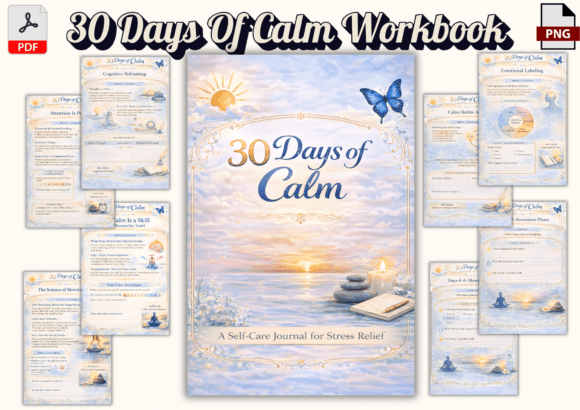
Like any tool, the 30 Days of Calm – Guided Journal works best when you approach it with realistic expectations. It is twenty pages long and designed as a thirty-day experience, which means each entry is manageable and focused. That is a strength for people who struggle to stick with longer programs, but it also means the journal is meant to be revisited rather than rushed through in a weekend.
Some users may find that certain prompts feel repetitive or too simple at first. That is actually intentional. Repetition is how habits form, and the simplicity is what makes the exercises accessible even on days when you are tired or distracted. If you are someone who prefers deep psychological analysis or long-form writing, you might supplement the journal with additional reflective practice, but for most people, the structure hits a sweet spot between guidance and freedom.
Another consideration is that the journal focuses heavily on emotional awareness and nervous system regulation rather than on goal setting or productivity. If you are looking for a planner that helps you organize your schedule, this is not that product. But if you are looking for something that helps you feel less reactive and more present so you can actually follow through with the goals you already have, it complements those efforts beautifully.
How different people use it differently
One of the most interesting things about the 30 Days of Calm – Guided Journal is how its use shifts depending on who is holding it. A therapist might recommend it to a client as a supplement to their sessions. A busy parent might use it as a five-minute reset in the middle of a chaotic afternoon. A freelancer might incorporate it into their morning routine to set the tone before diving into work. A college student might use it to manage exam anxiety and build better study habits.
The journal does not prescribe one right way to use it. That flexibility is part of what makes it effective across different lifestyles. Some people write in it first thing in the morning. Others prefer to reflect in the evening. Some read the mini lessons and think about them during the day, then write their responses later. The structure supports all of these approaches without making you feel like you are doing it wrong.
Practical takeaways you can actually feel
After working through the thirty days, most users report noticing real shifts in how they handle stress. Not because the journal magically removes challenges from their life, but because it gives them language and techniques to meet those challenges differently. That feeling of being constantly on edge starts to loosen. The habit of taking a few grounding breaths before reacting becomes automatic. The awareness of emotional triggers becomes sharper, and with that awareness comes the ability to choose a response instead of being driven by impulse.
The 30 Days of Calm – Guided Journal does not promise a completely stress-free life. What it offers is more realistic and more valuable: a reliable way to return to calm when life gets loud. For anyone who has ever felt like their own mind is their biggest source of exhaustion, that is a meaningful shift worth making space for.