The Medical Journal: A Structured Approach to Clinical Documentation and Patient Record Management
Healthcare documentation has long been a cornerstone of effective medical practice, yet its execution often falls short of the precision required for truly coordinated care. Paper charts can be unwieldy, digital systems may lack flexibility, and the gap between what a clinician observes and what is recorded can lead to fragmented treatment. A well-designed Medical Journal bridges this gap by offering a structured, portable, and comprehensive system for capturing every aspect of a patient's health journey. This article explores how such a logbook functions across different care settings, who benefits most from its use, and what makes it an indispensable tool in modern healthcare management.
The Role of Structured Documentation in Patient Safety
Clinical documentation is not merely a record-keeping exercise; it is a safety mechanism. When a patient transitions from a primary care physician to a specialist, or from hospital to home care, the continuity of information directly affects outcomes. A Medical Journal that centralizes patient demographics, medical history, allergies, and current medications provides an at-a-glance reference that reduces the risk of adverse events. For example, a caregiver managing an elderly relative with multiple chronic conditions can quickly verify that a newly prescribed medication does not conflict with existing treatments. Similarly, a practitioner reviewing lab results alongside daily clinical notes can identify trends—such as a gradual rise in blood pressure—that might otherwise be lost in scattered records.
The inclusion of dedicated pages for known allergies and medication tracking is particularly critical. In emergency situations, where time is scarce, having this information readily available can prevent serious reactions. The journal's structure ensures that such data is not buried within lengthy narratives but is instead presented in a standardized, easy-to-locate format.
Healthcare Practitioners
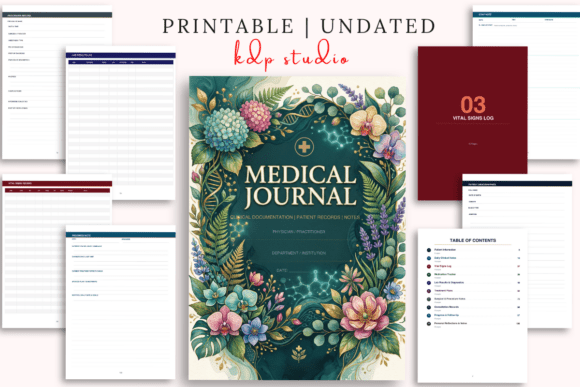
For doctors, nurses, and allied health professionals, the Medical Journal serves as a portable extension of their clinical memory. When seeing patients in multiple locations or covering for a colleague, a standardized log ensures that nothing is overlooked. The 16 pages dedicated to daily clinical notes allow for detailed observations, while the vital signs log—spanning 10 pages—enables longitudinal tracking of metrics like heart rate, temperature, and oxygen saturation. This is especially valuable in outpatient settings where patients may not have continuous access to electronic health records. A physician managing hypertension can use the journal to compare readings across visits and adjust treatment plans based on objective data rather than patient recall.
Patients and Self-Managers
Individuals who actively participate in their own healthcare—such as those with diabetes, autoimmune disorders, or cardiac conditions—find immense value in a personal Medical Journal. It empowers them to record symptoms, track medication adherence, and prepare for medical appointments. Instead of relying on memory, they present their provider with a clear timeline of their health status. For instance, a patient with rheumatoid arthritis can document daily pain levels, morning stiffness duration, and medication side effects, enabling the rheumatologist to fine-tune therapy with greater accuracy. This shift from passive recipient to active participant improves both communication and outcomes.
Caregivers and Family Members
Caring for a loved one with complex needs often involves coordinating among multiple providers, managing medication schedules, and monitoring subtle changes in condition. A Medical Journal provides a single source of truth that all caregivers can reference. Whether it is a home health aide noting a change in appetite or a daughter tracking her mother's postoperative recovery, the journal ensures consistency. The section for surgical notes and treatment plans becomes a roadmap that guides daily care decisions. This is particularly relevant for dementia care, where cognitive decline makes patient self-reporting unreliable, and a structured log becomes the primary tool for communication between family and clinical teams.
Primary Care and Chronic Disease Management
In a primary care practice, the Medical Journal complements electronic health records by providing a tangible, always-accessible record that patients can bring to every visit. For chronic conditions like diabetes, the lab results and diagnostics section—spanning 12 pages—allows for systematic logging of HbA1c levels, lipid panels, and renal function tests. The physician can visually track progression over time and discuss trends directly with the patient during the consultation. This collaborative approach enhances understanding and encourages adherence to treatment plans.
Surgical and Postoperative Care
For patients undergoing surgery, the journal becomes a critical tool for perioperative management. Preoperative assessment details, surgical notes, and postoperative recovery logs can be kept in one place. The caregiver can record wound healing, pain levels, medication schedules, and any signs of infection. When the patient attends follow-up appointments, the surgeon has a complete picture of the recovery process, reducing the need for repeated questioning and minimizing the risk of missed complications. The structured format helps ensure that no detail—such as a change in drainage or a new allergy—is omitted.
Home Health and Long-Term Care
Home health aides and hospice teams often work in environments where access to digital records is limited. A Medical Journal provides a reliable paper-based system that can travel with the patient. It includes sections for daily clinical notes, vital signs, and medication administration records, all of which are essential for regulatory compliance and quality assurance. In long-term care facilities, where multiple aides may attend to the same resident, the journal ensures that shift transitions are seamless. The ability to flip through recent entries allows staff to quickly assess the resident's current status and any recent changes.
Enhancing Communication and Care Coordination
One of the most significant advantages of a unified Medical Journal is its role as a communication bridge. In a fragmented healthcare system, information often resides in silos—a specialist's notes are separate from the primary care file, and hospital discharge summaries may not reach the home care team. A patient-carried journal centralizes these records, enabling each provider to see the full context. For example, a cardiologist can review the notes from the patient's endocrinologist regarding diabetes management, ensuring that heart failure treatment does not interfere with glycemic control. This level of coordination is especially important in geriatric care, where polypharmacy and multimorbidity are common.
The journal also facilitates conversations between patients and providers. When a patient brings a well-maintained log to an appointment, the visit becomes more productive. Instead of spending time reconstructing history, the clinician can focus on interpretation and planning. The patient feels heard and involved, which builds trust and satisfaction. For caregivers, the journal provides a framework for asking informed questions and advocating for the patient's needs.
Comprehensiveness and Flexibility
Not all journals are created equal. A Medical Journal that offers distinct sections for patient information, clinical notes, vital signs, medication tracking, and lab results provides the depth needed for complex care. However, flexibility is equally important. The user should be able to adapt the pages to their specific needs—for example, using the diagnostic section for imaging results or allergy testing. The 120-page capacity in this design allows for extensive use without becoming unwieldy. Users should consider whether the journal's structure aligns with their typical documentation requirements. For a patient with multiple comorbidities, the medication tracker and vital signs log will see heavy use; for a caregiver focused on postoperative care, the surgical notes section may be the priority.
Durability and Portability
In clinical environments, documents are subjected to frequent handling, spills, and transport. A journal that lies flat, has a sturdy cover, and uses quality paper will withstand daily use. Portability is also a factor—it should fit into a standard bag or medical kit without adding excessive bulk. The design of this particular logbook prioritizes both durability and portability, making it suitable for use in hospitals, clinics, and home visits.
Compliance and Privacy
While a paper journal does not face the same cybersecurity risks as digital records, it still requires responsible handling. Users must ensure that the journal is stored securely and that sensitive information is not exposed to unauthorized individuals. Some users may choose to use initials or codes instead of full names for certain entries, though for clinical accuracy, complete data is preferable. The journal's role as a patient-carried document means that the patient or caregiver takes responsibility for its safekeeping, which is an important consideration for those concerned about privacy.
The Journal as a Tool for Diagnostic Clarity
The diagnostics and treatment section of a Medical Journal is where the most impactful clinical reasoning occurs. With 12 pages dedicated to lab results, imaging reports, and treatment outcomes, the user can create a chronological map of the patient's diagnostic journey. For a patient undergoing chemotherapy, this section can track blood counts, tumor markers, and side effect severity over successive cycles. The oncologist can use this data to assess response to treatment and make timely adjustments. Similarly, for a patient with an undiagnosed condition, the journal becomes a living document that accumulates clues—symptom patterns, lab anomalies, and specialist opinions—that may eventually lead to a diagnosis.
The act of recording itself also promotes clinical vigilance. When a practitioner or caregiver writes down observations regularly, they are more likely to notice deviations from the norm. A subtle change in blood pressure or a new symptom may be dismissed if it is not documented, but when it appears in a log alongside previous entries, it demands attention. This is the essence of evidence-based practice at the individual patient level.
Supporting Preventive Care and Wellness
Beyond acute and chronic management, a Medical Journal can support preventive health. Patients who track their vital signs, weight, and lifestyle habits over time can identify risk factors early. For example, a middle-aged individual who logs their blood pressure readings at home may detect prehypertension before it progresses to a full-blown diagnosis. They can then discuss lifestyle modifications with their physician, using the journal as evidence of their efforts. The medication tracker also serves as a reminder for adherence, which is a cornerstone of both treatment and prevention. By making health data visible and actionable, the journal encourages proactive self-care.
Observations on the Future of Personal Health Records
As healthcare moves toward more patient-centered models, tools that empower individuals to manage their own data will become increasingly important. The Medical Journal represents a hybrid approach—combining the reliability of paper with the structure of a formal system. While digital apps and portals offer convenience and data analysis, they often require internet access, device compatibility, and a certain level of technical literacy. A paper journal remains universally accessible, requires no batteries, and can be used in any setting. For many patients and caregivers, especially those who are older or live in underserved areas, this makes it the most practical option.
Moreover, the act of writing has cognitive benefits. Studies suggest that handwriting information improves retention and understanding compared to typing. A patient who records their symptoms and medication changes is more likely to remember them during a consultation. For caregivers, the process of documenting care activities reinforces their understanding of the patient's condition and enhances their ability to detect changes. These factors contribute to the journal's value as more than just a record—it is a tool for learning and engagement.
Practical Tips for Getting the Most Out of a Clinical Journal
To maximize the benefits of a Medical Journal, users should establish a consistent documentation routine. For practitioners, this might mean completing the clinical notes immediately after each patient encounter, while details are fresh. For caregivers, setting aside a few minutes each day to log vital signs and observations ensures that the record remains current. It can be helpful to use the journal in conjunction with appointment reminders—bringing it to every visit and asking the provider to review recent entries. Over time, the accumulated data becomes a powerful tool for identifying patterns and guiding decisions.
Users should also consider color-coding or using tabs to mark frequently accessed sections. The journal's layout is designed for ease of navigation, but personalization can further streamline use. For example, a caregiver managing a patient with multiple allergies might tab the allergy page for instant reference. A diabetic patient might mark the lab results section for quick comparison of glucose trends. These small adjustments enhance the journal's utility without compromising its structure.
Finally, it is important to periodically review the journal to ensure that the information remains accurate and complete. As conditions evolve and medications change, outdated entries should be updated or flagged. This practice not only maintains the journal's integrity but also reinforces the user's engagement with the patient's health status. A living document that grows and adapts with the patient is far more valuable than a static record that is only consulted during crises.
The Medical Journal is more than a collection of pages—it is a framework for disciplined, compassionate, and effective care. By centralizing the information that matters most, it supports safer clinical decisions, stronger patient-provider relationships, and more coordinated care across all settings. For anyone involved in the delivery or management of healthcare, it is a resource that transforms documentation from a chore into a strategic asset.